Author: admin

  • Men’s Health Panels vs TRT Panels: What Is Included?

    Men’s health · Panel comparison

    Men’s Health Panels vs TRT Panels: What Is Included?

    By Order My Own Labs · Updated October 27, 2026

    Direct answer: A men’s wellness panel and a testosterone replacement therapy (TRT) panel can contain very different tests. Some wellness packages contain no testosterone measurement. Some TRT packages contain hormones and blood counts but no cholesterol or metabolic panel. Compare the actual components with the question your clinician needs answered.

    Compare six supplied panel listings

    Price reference: supplied Ulta listings, October 27, 2026. These are not verified live checkout quotes. Confirm the exact laboratory order, eligibility, collection instructions and total fees before purchasing.

    Panel Supplied price Components listed Difference to notice
    Basic Health Profile — Men’s $112.95 CBC with differential/platelets, CMP, lipid panel, complete urinalysis, PSA total No testosterone measurement is listed.
    Testosterone Replacement Package I $109.95 Total/free testosterone with SHBG, estradiol, CBC with differential/platelets No PSA, CMP or lipid panel is listed.
    Testosterone Replacement Package I (Estradiol, Ultrasensitive) $124.95 Total/free testosterone with SHBG, ultrasensitive estradiol LC/MS/MS, CBC with differential/platelets Different estradiol assay listing; confirm the method needed.
    Testosterone Replacement Therapy (TRT) Plus Panel $156.95 Total/free testosterone with SHBG, estradiol, CBC, CMP, PSA free and total No lipid panel is listed. Do not confuse this with “Testosterone Replacement Package Plus.”
    Hormone Therapy Safety — Essential Lab Panel $248.00 CBC, CMP, lipid panel, A1c, hs-CRP, ferritin, iron/TIBC, TSH, free T4, magnesium, vitamin D, complete urinalysis No testosterone or estradiol measurement is listed despite the hormone-therapy name.
    Hormone Therapy Safety — Advanced Male Lab Panel $560.00 Essential safety markers above, plus total/free testosterone with SHBG, ultrasensitive estradiol, DHEA-S, DHT, PSA free/total, prolactin, FSH/LH, CK, ApoB and Lp(a) Many more measurements; whether they are useful depends on the monitoring plan.

    These are summaries of the supplied component lists, not guarantees about a current order. “TRT Plus,” “Package Plus” and “Package II” are distinct names. Compare the full title and components instead of assuming that similar labels describe the same product.

    Choose the purpose before the package

    General wellness

    A wellness comparison may focus on blood counts, glucose, cholesterol, kidney or liver markers, depending on the person’s history. A package containing these measurements does not automatically investigate testosterone deficiency. Likewise, having more biomarkers does not establish that every test is appropriate for routine screening.

    Evaluation of suspected low testosterone

    The Endocrine Society recommends diagnosis only when compatible symptoms or signs occur with consistently and unequivocally low testosterone. It recommends confirming with a repeat morning fasting total testosterone measurement, and advises against routine screening of the general male population. A single panel purchase cannot establish the diagnosis by itself. Source 1

    Monitoring prescribed TRT

    Monitoring addresses treatment response and adverse effects, with testing selected by the prescriber. Blood counts and prostate-related assessment may matter, but a commercial package is not a complete monitoring plan. Collection timing can depend on the formulation and dose schedule. Do not use an untreated person’s collection instructions or change your dose from a panel result alone. Source 1

    PSA and cancer-marker wording need context

    PSA testing requires a discussion of possible benefits and harms. The USPSTF recommends an individual decision for screening men aged 55–69 and recommends against routine PSA-based screening at age 70 or older. Symptoms or known prostate disease involve different decisions. A PSA result alone does not diagnose cancer. Source 2

    Do not treat a broad “cancer screening” package as a substitute for recommended screening. NCI explains that circulating tumor markers generally have not performed well for screening people without symptoms. A larger list of markers does not establish better early detection. Source 3

    Check overlap before paying

    1. Write the exact measurements requested by your clinician.
    2. Mark measurements already included in an existing order.
    3. Check whether testosterone is total only, total/free, or total/free with SHBG; clarify the free-testosterone method.
    4. Distinguish standard estradiol from ultrasensitive LC/MS/MS.
    5. Confirm whether PSA is total only or free and total.
    6. Ask which collection time, fasting instructions and follow-up plan apply.
    7. Compare the final fees and required additional orders.

    For example, the supplied $156.95 TRT Plus panel already lists CBC and CMP. Buying those again for the same planned collection could duplicate testing. A clinician-directed repeat on another date is a different purpose.

    Read the total versus free testosterone comparison, lipid test guide and BMP versus CMP guide for the individual measurements.

    Compare testosterone listings →

    Sources and editorial information

    Clinical sources checked October 27, 2026. Panel components and prices are transcribed from supplied Ulta Lab Tests listings; they have not been independently confirmed against a current order or checkout. Prepared with AI-assisted research and editorial checks. No independent clinical review is claimed.

    1. Endocrine Society: Testosterone Therapy Guideline
    2. USPSTF: Prostate Cancer Screening
    3. National Cancer Institute: Tumor Markers

    Suggest a correction · Editorial standards

    Medical disclaimer

    This guide is educational and does not provide individual medical advice, diagnosis or treatment. A qualified healthcare professional should help select tests and interpret results. Follow the actual ordering provider’s instructions.
  • Immunity Titer Panels: MMR, Hepatitis B, Varicella and TB

    Immunity & titers · Panel comparison

    Immunity Titer Panels: MMR, Hepatitis B, Varicella and TB

    By Order My Own Labs · Updated October 27, 2026

    Direct answer

    Match an immunity panel to the exact school, employer or clinical requirement before ordering. MMR and varicella IgG, hepatitis B surface antibody, hepatitis B infection screening and a TB blood test answer different questions. One panel name does not guarantee that every required item is included.

    Compare immunity panels, student titers and individual tests

    Use this table to identify the test names on your requirement form. The component lists below come from the supplied Ulta catalog; they do not establish what a particular institution will accept.

    Supplied prices dated October 27, 2026. Confirm current components, fees, eligibility, collection and turnaround with the provider. These are references, not live checkout quotes.

    Supplied offering Price Listed contents Key distinction
    Immunity Panel $132.95 MMR IgG panel, varicella-zoster IgG and quantitative hepatitis B surface antibody No TB test or hepatitis A antibody in the supplied list
    Immunity Panel Plus $152.95 The Immunity Panel measurements plus hepatitis A total antibody Adds hepatitis A; TB is still not listed
    Student Titers Panel $285.80 MMR IgG panel, varicella-zoster IgG, quantitative hepatitis B surface antibody and QuantiFERON-TB Gold Plus Adds TB infection screening; this is not a test of TB vaccine immunity
    Hepatitis B Surface Antibody Quantitative Test $33.95 Anti-HBs concentration Not the same as the hepatitis B triple panel
    Hepatitis B Titer Test Panel $81.95 Surface antibody, surface antigen with reflex confirmation and total core antibody Contains three different hepatitis B markers
    Measles, Mumps, Rubella (MMR) Immunity Profile $64.95 Measles, mumps and rubella antibodies Confirm the exact assay, reported results and institution’s requirements
    MMR Titer Test $66.95 Measles, mumps and rubella antibodies A different listing name and price; do not assume analytical identity
    QuantiFERON-TB Gold Plus Tuberculosis Test $149.95 TB blood test, also called an IGRA Does not replace MMR, hepatitis B or varicella documentation

    Is a bundle always cheaper?

    Not necessarily. In the supplied list, the $132.95 Immunity Panel plus the $149.95 standalone TB test totals $282.90, compared with $285.80 for Student Titers. That $2.90 arithmetic difference is not a guarantee of an equivalent final order. Collection arrangements, laboratory methods, fees, restrictions and the accepting institution’s rules still need to match.

    Similarly, adding an MMR panel to an Immunity Panel repeats a named group already included. Start with the required components, then compare the complete checkout cost.

    Hepatitis B surface antibody or surface antigen: which one is on the form?

    Surface antibody (anti-HBs) is used in assessing immune response. Surface antigen (HBsAg) is an infection marker. Total core antibody (anti-HBc) helps assess prior or ongoing infection and does not arise from vaccination alone. These names are easy to confuse but are not interchangeable. CDC’s adult screening approach uses all three markers as a triple panel. [1]

    If a form asks for a quantitative hepatitis B surface antibody, a surface-antigen-only order does not provide that measurement. Conversely, an antibody-only titer does not supply all three markers in the screening panel. Compare the wording before selecting the product.

    What does 10 mIU/mL mean?

    In the appropriate setting after a documented complete vaccine series, CDC uses anti-HBs of at least 10 mIU/mL as a marker of vaccine response. Timing and previous records matter; a late low result does not by itself distinguish an original non-response from waning detectable antibody. Ask occupational health or the clinician to interpret it and determine follow-up. [2]

    Can a negative varicella titer mean a vaccinated person is unprotected?

    A negative commercial antibody test does not automatically settle that question. CDC notes that commercial assays may miss vaccine-induced immunity. Documented age-appropriate vaccination is itself one form of evidence of immunity. Show the vaccine record and laboratory report to the accepting program or clinician rather than assuming another purchase is the next step. [3]

    The supplied catalog includes both a Varicella Titer Test ($47.95) and a Varicella Immunity Screen ($90.95). Their names and promotional descriptions do not establish that either assay reliably detects every vaccine response. Request the specific assay information and acceptance requirements before paying more for a differently named test.

    Do I need IgM as well as IgG for MMR documentation?

    Do not substitute an infection-focused order for the required immunity documentation. CDC identifies measles IgG as the laboratory marker used for evidence of measles immunity. IgM testing belongs to a different evaluation and can produce false positives in people who do not have measles. [4]

    Why is TB screening included in some student panels?

    A TB blood test assesses immune response related to TB infection. It is not an antibody titer proving vaccine protection. A positive result requires medical evaluation; the blood test alone cannot distinguish latent infection from active TB disease. Symptoms also require assessment regardless of a screening result. [5]

    Check whether your program specifically accepts QuantiFERON-TB Gold Plus, another IGRA or a skin-test process, and whether it requires a particular completion window. Do not assume that a panel titled “Student” meets every placement site’s documentation rules.

    A practical checklist before ordering

    1. Get the exact written requirements and review existing vaccine and test records.
    2. Match every required marker: MMR components, varicella IgG, quantitative hepatitis B surface antibody, and TB testing if requested.
    3. Confirm whether infection screening, rather than immunity documentation, is also required.
    4. Ask whether the report must show numeric results, reference intervals, collection date or other details.
    5. Check collection availability and the provider’s actual turnaround; allow for follow-up if needed.
    6. Confirm who will review a negative, equivocal, indeterminate or positive result.

    Vaccination records and antibody results can require interpretation together. Ordering a larger panel cannot guarantee acceptance, protection against future infection or clearance to work.

    Browse titer listings · Review costs and ordering questions

    Sources and editorial information

    Clinical sources checked October 27, 2026. Panel components and prices are transcribed from supplied Ulta Lab Tests listings; they have not been independently confirmed against a current order or checkout. Prepared with AI-assisted research and editorial checks. No independent clinical review is claimed.

    1. CDC: Clinical testing and diagnosis for hepatitis B
    2. CDC: Hepatitis B vaccine protection and antibody testing in healthcare settings
    3. CDC: Varicella vaccine recommendations and evidence of immunity
    4. CDC: Measles serology testing
    5. CDC: Clinical and laboratory diagnosis for tuberculosis

    Suggest a correction · Editorial standards

    Medical disclaimer

    This guide is educational and does not provide individual medical advice, diagnosis or treatment. A qualified healthcare professional should help select tests and interpret results. Follow the actual ordering provider’s instructions.
  • Women’s Hormone Panels: Compare Tests, Timing and Prices

    Hormones · Panel comparison

    Women’s Hormone Panels: Compare Tests, Timing and Prices

    By Order My Own Labs · Updated October 27, 2026

    Direct answer

    A women’s hormone panel may contain reproductive hormones alone, or may add thyroid, adrenal and pituitary measurements. Compare the actual component list and collection timing. “Basic,” “reset” and “comprehensive” are product names, not standardized medical definitions.

    What is included in these four women’s hormone panels?

    The following comparison uses the exact named offerings supplied for our directory. It is a shopping reference for discussing an order, not a recommendation to buy a panel.

    Supplied prices: October 27, 2026. Current prices, fees, eligibility, assay methods and components must be confirmed with the provider.

    Panel and supplied price Reproductive and androgen measurements listed Other measurements listed
    Female Basic Hormone Panel Blood Test
    $98.95
    DHEA-S; free and total testosterone; progesterone; estradiol No thyroid, cortisol, prolactin, FSH/LH or separately named SHBG in the supplied component list
    Hormone Reset – Female Hormone
    $185.95
    DHEA-S; total/free testosterone with SHBG; progesterone; estradiol; FSH and LH No thyroid, cortisol or prolactin in the supplied component list
    Reproductive Hormones – Comprehensive
    $198.95
    DHEA-S; total/free testosterone with SHBG; progesterone; estradiol; FSH/LH; total estrogen; 17-hydroxyprogesterone No thyroid, cortisol or prolactin in the supplied component list
    Women’s Hormone Harmony Panel
    $298.00
    DHEA-S; free/total testosterone; progesterone; estradiol; FSH/LH TSH, free T4, free T3, morning cortisol and prolactin; SHBG is not separately named in the supplied list

    “Not listed” means absent from the supplied component list, not a claim about an unverified current assay. Ask the provider for the final laboratory order. A panel’s testosterone method may differ from another panel’s method even when both say “free and total.”

    Does a larger hormone panel answer every question?

    No. The $198.95 reproductive panel adds total estrogen and 17-hydroxyprogesterone compared with the $185.95 Reset listing. The $298 Harmony listing instead adds thyroid measurements, morning cortisol and prolactin. Those are different sets of questions, not simply four levels of the same test.

    None of these supplied lists includes a CBC, ferritin, a metabolic panel, A1c or a lipid panel. If those are part of a clinician’s evaluation, they need to be accounted for separately. Conversely, an existing thyroid order may already cover the thyroid measurements in Harmony.

    Write down the question before choosing the package: irregular periods, a fertility evaluation, possible androgen excess, symptoms that overlap with thyroid disease, or monitoring prescribed treatment. The clinician may select a narrower set or use different collection dates. A panel label does not establish a diagnosis.

    For background, see our thyroid testing guide and total versus free testosterone comparison.

    Can all the hormones be checked on the same day?

    A convenient single draw is not always the most informative collection. When progesterone is being used to assess ovulation, ASRM recommends timing it roughly one week before the next expected period rather than assigning every person “day 21.” A single result cannot evaluate the quality of the luteal phase. [1]

    Give the clinician the first day of your last period, usual cycle length, whether cycles are predictable, and the purpose of testing. Also list contraception, prescribed hormones, supplements and the timing of recent doses. Ask which instructions apply to each selected measurement. Do not stop or change treatment to prepare for a test without guidance.

    Do I need FSH testing to establish menopause?

    Not routinely in otherwise healthy people aged 45 or older with typical symptoms and the appropriate menstrual history. NICE guidance generally identifies perimenopause and menopause clinically in that setting. A clinician may use testing for selected younger people or when another cause needs investigation. An FSH-containing panel is therefore not automatically the starting point for every reader with hot flashes. [2]

    How do I avoid paying twice for the same hormone?

    Use a component checklist rather than comparing the advertised biomarker count. Mark estradiol, progesterone, testosterone outputs, SHBG, DHEA-S, FSH, LH, prolactin, thyroid measurements and cortisol on every proposed order.

    For example, adding a separate estradiol order to the Reset panel for the same collection would overlap with a listed measurement. Adding a separate FSH/LH order to Harmony would overlap too. A deliberately timed repeat or a different method may have a purpose, but that should be explicit.

    Total estrogen and estradiol are different named measurements; do not count them as identical. Similarly, “free testosterone” does not tell you whether it was measured or calculated. Ask whether the result method and reference interval fit the intended use.

    Questions to settle before ordering

    1. Which symptom or monitoring decision will this order address?
    2. Which components are already on my existing orders?
    3. Which cycle day, clock time or dose interval applies?
    4. Are SHBG and the relevant testosterone method actually included?
    5. What is the complete cost, including fees and any later repeat collection?
    6. Who will interpret the results and arrange follow-up?

    Is the cheapest panel always the best value?

    Only if its components and methods answer the intended question. Paying less for an incomplete order can lead to another collection; paying more for unrelated measurements does not by itself improve an evaluation. Compare the final order, not the savings percentage.

    Can I use these prices as checkout quotes?

    No. They are dated references from the supplied listings. Search the hormone listings, then confirm the current offer, exact components, eligibility and collection instructions with Ulta before paying.

    Sources and editorial information

    Clinical sources checked October 27, 2026. Panel components and prices are transcribed from supplied Ulta Lab Tests listings; they have not been independently confirmed against a current order or checkout. Prepared with AI-assisted research and editorial checks. No independent clinical review is claimed.

    1. ASRM: Fertility evaluation of infertile women (2026)
    2. NICE: Menopause—identifying perimenopause and menopause

    Suggest a correction · Editorial standards

    Medical disclaimer

    This guide is educational and does not provide individual medical advice, diagnosis or treatment. A qualified healthcare professional should help select tests and interpret results. Follow the actual ordering provider’s instructions.
  • Total vs Free Testosterone: Which Test Answers Your Question?

    Total vs Free Testosterone: Which Test Answers Your Question?

    Hormones · Educational guide

    Total vs Free Testosterone: Which Test Answers Your Question?

    By Order My Own Labs · Updated October 27, 2026

    Total vs Free Testosterone: Which Test Answers Your Question? — editorial illustration of two laboratory reports, a clock and blood samples.
    Direct answer

    Total testosterone includes protein-bound and unbound testosterone; free testosterone refers to the unbound fraction. They answer related but different questions. For suspected low testosterone in adult men, diagnosis requires an appropriate clinical assessment and consistently low results—not one afternoon measurement or symptoms alone.

    What is the difference between total, free and bioavailable testosterone?

    Name on the order What the result represents What to clarify
    Total testosterone The combined protein-bound and unbound testosterone concentration. Which assay and reference interval will be used?
    Free testosterone The unbound fraction. Is it measured, or calculated from other results?
    Bioavailable testosterone Free testosterone plus the fraction weakly bound to proteins such as albumin. Which measurements and calculation does this package include?
    SHBG Sex hormone-binding globulin, a protein involved in hormone binding. Is it included to help interpret the testosterone results?

    Most circulating testosterone is protein-bound. These results are not interchangeable and may use different units. Do not compare a free-testosterone number directly with a total-testosterone reference interval. [1] [2]

    Who is this comparison intended for?

    This guide mainly addresses test-order questions for adult men being evaluated for possible testosterone deficiency. Testosterone is also present in women and is measured for other reasons, including some evaluations of androgen excess. Children, adolescents, people using gender-affirming hormones, and people already receiving testosterone need context-specific interpretation. [1]

    A commercial “hormone panel” is not a universal assessment of every hormone. Start with the symptom or monitoring question, then ask which measurement and collection timing would inform the next decision.

    Why can SHBG change how total testosterone is interpreted?

    Two people with a similar total testosterone concentration may have different binding-protein levels. SHBG can therefore help explain why the total concentration does not tell the whole story. A clinician may consider free testosterone when total testosterone is borderline or a condition affecting SHBG is suspected. [2] [5]

    SHBG can be affected by several health conditions and medicines. Obesity and some metabolic conditions may be associated with lower SHBG; other circumstances may raise it. A binding-protein result should be interpreted, not automatically treated as a target to raise or lower. [5]

    The practical ordering question is specific: does this package contain total testosterone alone, total plus free testosterone, or total testosterone with SHBG and other values used for a calculation? Check the components rather than relying on a label such as “advanced.”

    Why does the collection time matter?

    For adult men being assessed for low testosterone, professional guidance emphasizes morning collection. Levels vary over the day and from one day to another. The Endocrine Society recommends confirming the diagnosis with a repeat morning fasting total testosterone measurement, in the appropriate clinical setting. [3]

    Ask for the actual time window, fasting instructions, and advice about illness, sleep schedule, medicines, and supplements before booking. Someone working overnight should discuss timing rather than assume an ordinary morning appointment provides equivalent conditions. [4]

    If you already use prescribed testosterone, monitoring may need to be timed to the formulation and dose schedule. Do not use instructions for an untreated person as a substitute for your prescriber’s monitoring plan. [1]

    Are all free-testosterone tests performed the same way?

    No. Free testosterone may be measured using an appropriate laboratory method, or estimated using total testosterone, SHBG, and albumin. Quest describes equilibrium dialysis and a calculated approach as different test options. A product name alone may not identify the method. [4]

    Ask whether “free testosterone” is directly measured or calculated, which inputs are used, and which reference interval belongs to that result. Keep the method and units when comparing reports. A cheaper test with a similar name may not be the same analytical product. [4]

    Method selection is particularly important when results are low or the clinical setting requires greater analytical sensitivity. Ask the clinician or laboratory which assay fits the question rather than selecting a method solely because it sounds more sophisticated. [4]

    Does one low result prove testosterone deficiency?

    No. Diagnosis requires compatible symptoms or signs and unequivocally, consistently low testosterone measured appropriately. A clinician may repeat the test and investigate why a result is low before deciding whether treatment is appropriate. [3] [6]

    When deficiency is established, LH and FSH can help investigate whether the problem relates primarily to the testes or to the pituitary–hypothalamic signaling system. Further evaluation depends on the findings; these are not automatic add-ons for every reader. [3] [5]

    A testosterone result is also not a standalone fertility test. If fertility is the concern, say so before choosing a package. ARUP directs that question to a separate infertility assessment. [5]

    What if fatigue is the main reason you are considering testing?

    Low energy is not specific to testosterone deficiency. Symptoms overlap with other conditions and require an assessment broader than one hormone result. A low or borderline value should be interpreted alongside the history, rather than used as an automatic explanation for every symptom. [6]

    Our blood tests for fatigue guide explains how to organize symptom history and avoid treating a package name as a diagnosis. If your clinician is also investigating thyroid or metabolic questions, compare existing orders before buying overlapping panels.

    Compare five supplied testosterone listings

    The word “testosterone” does not identify the same order in every listing. Here is a component-by-component comparison of five names in the supplied Ulta catalog.

    Price reference: supplied listings dated October 27, 2026. These are not verified live checkout quotes. Confirm fees, eligibility, specimen, assay method and included measurements with the provider.

    Supplied listing Price Measurements described Difference to check
    Testosterone Total Male Test (Adult Only) $29.95 Total testosterone Listed for males aged 18 or older; free testosterone and SHBG are not separately listed.
    Testosterone Total Test $52.95 Total testosterone Confirm method and eligibility. A different name or price does not establish that it is interchangeable with the adult-male listing.
    Testosterone Free and Total Test $54.95 Total and free testosterone Confirm the free-testosterone method. Do not assume a separately reported SHBG is included.
    Testosterone Total and Free and Sex Hormone Binding Globulin Test $62.95 Total testosterone, free testosterone and SHBG SHBG is explicitly named; verify whether free testosterone is measured or calculated.
    Testosterone Free, Bioavailable, and Total Test $94.95 Total, free and bioavailable testosterone, SHBG and albumin, as described in the supplied listing Compare the calculation, method, units and reference intervals rather than treating the extra outputs as automatically necessary.

    When would buying two of these duplicate testing?

    If a chosen panel already includes total and free testosterone, adding a second total-testosterone listing for the same intended collection may repeat a measurement. A clinician-directed repeat on a different day is a separate purpose. Mark the needed measurements first, then compare the order components.

    A $62.95 listing with SHBG is $8.00 above the supplied $54.95 free-and-total listing. That is a price difference, not proof that everyone needs SHBG or that the methods match. The clinical question and the actual laboratory order determine whether the added measurement is useful.

    Search testosterone listings in the directory →

    What should you ask before paying for a testosterone test?

    1. What question is the clinician trying to answer, and which measurement is needed first?
    2. Is this total testosterone alone, or does it include free testosterone, SHBG, and albumin?
    3. Is free testosterone measured or calculated, and what method is used?
    4. What collection time and fasting instructions apply?
    5. If a repeat is needed, is it a separate purchase?
    6. Who will interpret the result and decide on additional evaluation?

    Compare the full order cost, collection arrangements, fees, and follow-up support using the costs and ordering checklist. A single low price does not establish that two packages contain the same testing. The supplied price references above are not verified current checkout totals.

    Does a normal total testosterone always settle the question?

    Not necessarily. Binding-protein changes may make additional interpretation useful in selected situations. Ask whether free testosterone or SHBG would change the assessment rather than adding them automatically. [2]

    Where can I look up the related hormone names?

    The hormone test directory contains concise explanations. Use it to prepare specific questions for the person reviewing your results.

    Sources and editorial information

    Sources checked October 27, 2026. Prepared with AI-assisted research and editorial checks. No independent clinical review is claimed. This guide does not verify a provider’s current prices, checkout total, or individual eligibility.

    1. MedlinePlus: Testosterone Levels Test
    2. MedlinePlus: SHBG Blood Test
    3. Endocrine Society: Testosterone Therapy Guideline
    4. Quest Diagnostics: Hypogonadism FAQ
    5. ARUP Consult: Male Hypogonadism Testing Algorithm
    6. Endocrine Society: Hypogonadism in Men

    Suggest a correction · Editorial standards

    Medical disclaimer

    OrderMyOwnLabs.com provides educational information, not individual medical advice, diagnosis or treatment. A qualified healthcare professional should help select tests and interpret results. Follow the actual ordering provider’s instructions.
  • Liver Blood Tests: ALT, AST, ALP, GGT and Bilirubin Explained

    Liver Blood Tests: ALT, AST, ALP, GGT and Bilirubin Explained

    Liver · Educational guide

    Liver Blood Tests: ALT, AST, ALP, GGT and Bilirubin Explained

    By Order My Own Labs · Updated October 27, 2026

    Liver Blood Tests: ALT, AST, ALP, GGT and Bilirubin Explained — editorial illustration of a liver reference card, reports and blood samples.
    Direct answer

    Liver blood tests measure several different enzymes, proteins, and waste products. ALT and AST can help identify cell injury; ALP, GGT, and bilirubin add information about other patterns. Albumin and clotting tests address different aspects of liver function. No single value diagnoses the cause of a liver problem.

    What do the common liver blood tests measure?

    TestWhat it measuresImportant limitation
    ALTAlanine aminotransferase, an enzyme associated mainly with liver cells.A high value does not establish the cause.
    ASTAspartate aminotransferase, found in liver and other tissues.Muscle and other non-liver sources can affect the result.
    ALPAlkaline phosphatase, found in liver, bile ducts and bone.An abnormal value is not automatically liver-specific.
    GGTGamma-glutamyl transferase, an enzyme concentrated in the liver.It can help interpret another finding but cannot identify a specific cause alone.
    BilirubinA substance formed during red-cell breakdown and processed for removal.Total and direct bilirubin are different reported measurements.
    Albumin and total proteinProteins in the blood.These are not interchangeable with enzyme measurements.
    PT/INRClotting time and a standardized related result.This is a separate order and can be influenced by anticoagulant treatment and other factors.

    The label “liver function tests” covers measurements with different roles. Some mainly reflect injury or a particular pattern; others contribute information about function. The panel should be interpreted as a whole. [1] [2] [3] [4] [5] [6] [8]

    Are ALT and AST the same thing?

    They are different enzymes. ALT is more closely associated with liver cells, while AST is also found in muscle, heart, and other tissues. That is why an elevated AST cannot automatically be attributed to the liver. [2] [3]

    Context matters. Recent intense exercise, medicines, and supplements may affect some liver-related measurements. Bring a complete list rather than stopping a prescription on your own or assuming a supplement is irrelevant because it is sold as natural. [2]

    Ask whether the finding is isolated, how it compares with the laboratory’s upper reference limit, and whether the change is new. A pair of numbers without the rest of the report is a weak basis for deciding what to do next.

    Why are ALP and GGT sometimes interpreted together?

    ALP can come from liver-related tissues or bone. GGT can help a clinician investigate whether an ALP elevation is more consistent with a liver or bile-duct source. The two tests add context to each other; they are not duplicate names for the same measurement. [4] [5]

    An elevated GGT is not proof of one specific disease, and it should not be treated as proof of alcohol misuse. Medicines and several health situations can affect the result. Ask what the complete pattern suggests and whether further testing is needed. [5]

    If a listing advertises a liver panel, check whether GGT is actually included. Its absence or presence should be clear from the component list rather than inferred from a broad package name.

    What is the difference between total and direct bilirubin?

    Bilirubin comes from the breakdown of older red blood cells. The liver processes it for removal. Laboratories may report total bilirubin, direct bilirubin, and an indirect component. These names describe different parts of the measurement rather than separate organs. [6]

    An unexpected bilirubin result may relate to liver processing, bile flow, red-cell breakdown, or other circumstances. A total result alone does not settle which explanation applies. Ask whether the next step is a repeat, fractionated bilirubin, other blood work, or a clinical assessment. [6]

    New yellowing of the eyes or skin, especially with dark urine, pale stools, or abdominal pain, deserves medical assessment rather than waiting for a self-ordered panel to arrive. [6]

    Does a CMP contain a complete liver panel?

    A standard CMP includes several liver-related measurements, including ALT, AST, ALP, total bilirubin, albumin, and total protein. It also contains measurements related to other body systems. GGT, direct bilirubin, and PT/INR should not be assumed to be included. [7]

    A hepatic function panel and a CMP can therefore overlap without being identical. Check the precise list. Our BMP versus CMP guide explains why a basic metabolic panel is different again.

    Comparison questionWhat to check
    Does the order include GGT?Look for GGT explicitly.
    Is bilirubin total only?Check for direct or fractionated bilirubin if that is the requested order.
    Does the clinician need clotting information?Confirm whether PT/INR is a separate test.
    Am I duplicating recent blood work?Compare the existing report with the proposed order component by component.

    Do liver blood tests require fasting?

    Preparation depends on the exact order, the laboratory, and any other tests being collected. Ask the ordering provider whether fasting is required and for how long. Follow those instructions rather than using a blanket rule for every “liver panel.” [1]

    Tell the clinician about medicines, vitamins, herbal products, alcohol intake, recent illness, and unusual physical exertion. Ask whether any timing instructions apply. Do not deliberately change several habits immediately before the test just to obtain a better-looking number; the clinician needs an accurate picture of the collection conditions. [1] [2]

    If you have already eaten or did not follow an instruction, contact the laboratory before the draw. It may be possible to proceed with some measurements, but the decision belongs to the ordering service and collection team.

    Do abnormal results tell you the diagnosis?

    Usually not on their own. Clinicians look at the pattern across tests, the size and trend of the changes, symptoms, history, and other information. Results may lead to repeat blood work, tests for a particular cause, imaging, or another assessment. [1]

    A liver panel does not directly measure the amount of fat or scarring in the liver. It also does not independently rule out every liver condition. Ask what question remains unanswered after the blood results, rather than assuming the panel is a complete scan of the organ.

    Bring prior reports with dates and units. Record new medicines and supplements, recent illness, and the reason the test was ordered. That short timeline can be more useful for the follow-up conversation than buying another broad package.

    What should you check before ordering liver blood tests?

    1. Confirm the precise measurements needed for the clinical question.
    2. Compare the itemized panel with any recent CMP or other report.
    3. Check preparation and collection requirements for the full order.
    4. Compare the final cost, including any separate components and fees.
    5. Know who will interpret abnormal results and arrange follow-up.

    Use the liver test directory to look up individual terms and the ordering checklist to compare services. This guide does not verify a current price or claim that one panel suits every reader.

    Can a CBC replace liver testing?

    A CBC measures blood cells. It may be part of a broader evaluation but is not the same order as liver enzymes, bilirubin, or albumin. See our CBC explanation.

    Sources and editorial information

    Sources checked October 27, 2026. Prepared with AI-assisted research and editorial checks. No independent clinical review is claimed. This guide does not verify a provider’s current prices, checkout total, or individual eligibility.

    1. MedlinePlus: Liver Function Tests
    2. MedlinePlus: ALT Blood Test
    3. MedlinePlus: AST Test
    4. MedlinePlus: Alkaline Phosphatase
    5. MedlinePlus: GGT Test
    6. MedlinePlus: Bilirubin Blood Test
    7. MedlinePlus: Comprehensive Metabolic Panel
    8. MedlinePlus: Prothrombin Time and INR

    Suggest a correction · Editorial standards

    Medical disclaimer

    OrderMyOwnLabs.com provides educational information, not individual medical advice, diagnosis or treatment. A qualified healthcare professional should help select tests and interpret results. Follow the actual ordering provider’s instructions.
  • Kidney Function Tests: Creatinine, eGFR and Urine Albumin

    Kidney Function Tests: Creatinine, eGFR and Urine Albumin

    Kidney · Educational guide

    Kidney Function Tests: Creatinine, eGFR and Urine Albumin

    By Order My Own Labs · Updated October 27, 2026

    Kidney Function Tests: Creatinine, eGFR and Urine Albumin — editorial illustration of blood and urine samples beside a kidney reference card.
    Direct answer

    Kidney function testing often combines a blood-based estimate of filtration with a urine test for albumin. Creatinine and eGFR are related but different results; urine albumin-to-creatinine ratio, or uACR, adds another kind of information. A normal-looking creatinine number is not a complete kidney assessment.

    Which kidney tests measure what?

    MeasurementSample or calculationWhat it adds
    CreatinineUsually a blood measurement in this context.A waste-product measurement used to estimate filtration.
    eGFRCalculated from blood markers and other factors.An estimate of how well the kidneys filter; not a percentage read directly from blood.
    uACRA urine sample; albumin compared with urine creatinine.Helps assess albumin leakage, a marker of kidney damage.
    BUNBlood urea nitrogen.Additional information interpreted alongside other results.
    Cystatin CBlood measurement.An alternative marker that can help refine an eGFR estimate in selected circumstances.

    A provider may use more than one of these, but not everyone needs every test. Compare the exact included measurements and specimen types before choosing an order. [1] [2]

    Are creatinine and eGFR the same test?

    Creatinine is a substance measured in blood. eGFR is an estimate calculated using creatinine, cystatin C, or both, together with factors used by the equation. A laboratory report may therefore show both creatinine and an eGFR calculated from it. [2] [5]

    The relationship matters when comparing packages. A product displaying two result names may not represent two independent blood measurements. Ask which filtration marker and equation the report uses, and whether an eGFR will be reported for you. [5]

    When following a trend, bring the complete reports. A change in the underlying marker, equation, collection conditions, or health situation can matter; comparing only the bold eGFR number leaves out useful context.

    Why might a urine test be needed as well as blood work?

    Blood-based filtration estimates and urine albumin answer different questions. Albumin is a blood protein; finding excess amounts in urine may signal kidney damage. uACR compares urine albumin with urine creatinine to account for how concentrated the sample is. [1] [4]

    This is different from the albumin blood test in a chemistry panel. A package containing serum albumin does not automatically contain urine albumin or uACR. A general urinalysis is also a separate order; check whether a quantitative uACR is included rather than inferring it from the word “urine.” [2] [4]

    An abnormal urine result may need confirmation. Ask your clinician whether and when to repeat it, especially if the collection occurred during an unusual health situation. [1]

    Can muscle, diet, or supplements affect creatinine?

    Yes. Creatinine reflects more than filtration alone. Muscle mass, a large cooked-meat meal, intense exercise, creatine supplementation, and some medicines can affect the measurement. Their effect varies between people. [3]

    Tell the clinician and laboratory about these circumstances before drawing conclusions. An unexpected result should not automatically be dismissed as “just muscle” or “just supplements,” but it should not be interpreted without that history either. Do not stop prescribed medicines based on this guide. [3]

    If creatinine may provide an uncertain estimate, ask whether cystatin C or a combined calculation would help answer the clinical question. That is a targeted follow-up decision, not a reason for everyone to add another test. [2]

    Does one low eGFR mean chronic kidney disease?

    One result does not establish the full diagnosis or its duration. Clinicians consider persistent findings, evidence of kidney damage, urine results, and the clinical situation. A new decline can require assessment even when previous reports were reassuring. [6]

    An eGFR of 60–89 alone does not automatically establish chronic kidney disease. Evidence of kidney damage matters in that range. Conversely, an eGFR in a higher range does not make a urine albumin finding irrelevant. Ask your clinician to interpret the combination rather than relying on a simplified “good” or “bad” label. [5]

    Keep dates and units attached to each result. For uACR, reporting units must match before you compare numbers. For eGFR, use the laboratory’s reported result and discuss what a change means for your situation.

    Does a BMP or CMP include all the kidney tests?

    These chemistry panels commonly include creatinine and BUN, but a panel name does not guarantee urine albumin testing or cystatin C. Check the provider’s actual component list and whether an eGFR is reported. Our BMP versus CMP comparison explains the panel distinction. [2]

    Consider a practical comparison: one listing contains a CMP, while another contains creatinine with eGFR plus uACR. Neither name alone tells you which order fits the question. Itemize the measurements and any urine collection before comparing the totals.

    What should you ask before collection?

    • Does this order require blood, urine, or both?
    • Is the urine sample a spot sample, first-morning sample, or timed collection?
    • Do any tests in the complete order require fasting?
    • Should recent exercise, diet, supplements, illness, or medicines be documented?
    • Who will explain an unexpected result and decide whether it needs confirmation?

    Follow the collection instructions attached to the actual order. Do not replace them with a generic rule from another test package. Ask for clarification before collecting a sample if the instructions conflict.

    How can you compare kidney-test costs fairly?

    Write the test names, specimen requirements, collection charges, ordering fees, and result-support arrangements side by side. Compare like with like: a blood-only panel and a blood-plus-urine assessment are not identical purchases. A displayed laboratory price may not be the final total. See our costs and ordering guide. No live kidney-test price is verified here.

    Can early kidney disease have no symptoms?

    Yes. That is one reason clinicians use testing in people with relevant risks, including diabetes and high blood pressure. The testing interval depends on the person; absence of symptoms does not replace appropriate follow-up. [1]

    Where can I look up individual kidney tests?

    Use the kidney test directory for concise definitions and related entries. Bring your existing reports to avoid buying measurements you already have.

    Sources and editorial information

    Sources checked October 27, 2026. Prepared with AI-assisted research and editorial checks. No independent clinical review is claimed. This guide does not verify a provider’s current prices, checkout total, or individual eligibility.

    1. NIDDK: Chronic Kidney Disease Tests and Diagnosis
    2. National Kidney Foundation: Tests to Check Your Kidney Health
    3. National Kidney Foundation: Creatinine
    4. NIDDK: Albuminuria
    5. National Kidney Foundation: Estimated GFR
    6. NIDDK: Identify and Evaluate Patients with CKD

    Suggest a correction · Editorial standards

    Medical disclaimer

    OrderMyOwnLabs.com provides educational information, not individual medical advice, diagnosis or treatment. A qualified healthcare professional should help select tests and interpret results. Follow the actual ordering provider’s instructions.
  • Thyroid Blood Tests: TSH, Free T4 and T3 Explained

    Thyroid Blood Tests: TSH, Free T4 and T3 Explained

    Thyroid · Educational guide

    Thyroid Blood Tests: TSH, Free T4 and T3 Explained

    By Order My Own Labs · Updated October 27, 2026

    Thyroid Blood Tests: TSH, Free T4 and T3 Explained — editorial illustration of a thyroid reference card, laboratory reports and a blood sample.
    Direct answer

    Thyroid blood tests answer different questions. TSH measures a signal from the pituitary; free T4 measures available thyroxine; T3 can add information in selected situations, particularly suspected overactivity. Antibody tests investigate certain autoimmune causes. A larger panel is not automatically the right first order.

    What do the main thyroid blood tests measure?

    Test nameWhat it measuresQuestion to clarify
    TSHThe pituitary signal that helps regulate thyroid hormone production.Is this TSH alone, or a reflex order?
    Free T4The fraction of thyroxine not bound to blood proteins.Is the listed T4 free or total?
    Total T4Both bound and unbound thyroxine.Could binding-protein changes affect interpretation?
    T3Triiodothyronine; listings may specify total or free T3.Why is T3 relevant to this evaluation?
    Thyroid antibodiesImmune-system proteins directed against thyroid-related targets.Which antibody is included, and what cause is being investigated?

    These are separate measurements. A product called a “thyroid panel” may contain only some of them; its name is not a standardized promise of contents. [1] [3] [5]

    Why do clinicians often start with TSH and consider free T4?

    TSH provides information about the feedback system controlling the thyroid. Free T4 adds information about circulating thyroid hormone. Their relationship can be more useful than either number considered in isolation. The appropriate starting order depends on the question, existing thyroid disease, medicines, pregnancy, and possible pituitary problems. [2] [3]

    An abnormal TSH does not by itself identify the cause. It may lead to further testing rather than an immediate conclusion. Serious illness and other circumstances can also affect results. Bring previous reports so your clinician can compare the pattern and timing. [2]

    If you are choosing between TSH alone and an order that adds free T4 conditionally, read our TSH versus reflex thyroid testing guide. That guide focuses on the ordering algorithm; this one explains the measurements.

    Does everyone need a T3 test?

    No. T3 is often useful when a clinician is investigating an overactive thyroid, including some situations in which free T4 is not elevated. It is less useful as a routine way to rule out an underactive thyroid: a T3 result may remain within its range even when other findings show hypothyroidism. [1] [4]

    Ask what a T3 result would change in your evaluation. Also check whether the order specifies total or free T3. The word “complete” on a package does not answer either question.

    Are thyroid antibodies the same as thyroid hormones?

    They are different. Hormone measurements describe parts of thyroid function, while antibody testing can help investigate autoimmune conditions such as Hashimoto’s disease or Graves’ disease. TPO antibodies, thyroglobulin antibodies, and TSH-receptor-related tests are distinct orders. [5]

    An antibody result still needs the clinical picture and other laboratory findings. Do not treat a positive antibody as a direct measurement of how much thyroid hormone you have. Ask whether the test is intended to investigate a cause, support a diagnosis, or monitor a particular condition. [1]

    How should you prepare for thyroid blood work?

    Get instructions for the complete order. Ask about fasting, collection timing, and how the timing relates to any thyroid medicine you already take. Do not change a prescription simply to prepare for a self-purchased panel. [6]

    Tell the clinician and laboratory about biotin, including hair-and-nail products and multivitamins. Biotin can interfere with certain thyroid assays, producing misleading results. The appropriate interval to withhold a supplement depends on the product, dose, assay, and professional instructions; this guide does not assign one interval to every order. [1] [6]

    If you are combining thyroid tests with other blood work, follow the instructions for the combined collection rather than assuming that one test’s preparation applies to every component.

    What can thyroid results tell you—and what remains uncertain?

    A report provides measurements, units, and laboratory reference intervals. A clinician interprets combinations of findings alongside your symptoms and history. A single red flag on a report is not a complete diagnosis, and the same pattern may need different interpretation in pregnancy or pituitary disease. [2] [3]

    Write down the date, time, medicines and supplements taken, and any recent illness. If a repeat test is advised, ask whether using the same laboratory and comparable collection conditions would help. Do not compare numbers from different reports without checking the test name, units, and method. [6]

    If symptoms persist despite results within range, ask what else should be evaluated. Our fatigue testing guide explains why ongoing tiredness is not answered by one laboratory panel.

    What should you compare before buying a thyroid panel?

    1. Copy the exact list of included tests rather than relying on the package title.
    2. Separate TSH alone from reflex testing, and ask what triggers additional measurements or charges.
    3. Check free versus total T4 and T3, plus the exact antibody names.
    4. Confirm the collection network, location eligibility, preparation, and full cost.
    5. Identify who will explain results and arrange follow-up.

    For example, TSH alone, TSH with reflex free T4, and TSH plus separately ordered free T4 are different products. Comparing their prices without comparing their rules can give the wrong impression of value. Use our costs and ordering checklist. No current thyroid-panel price or provider-specific contents are verified in this guide.

    Common thyroid-testing questions

    Does a CBC include thyroid testing?

    A CBC measures blood cells. Do not assume that a CBC order contains TSH, T4, T3, or antibodies. Check the itemized order; see our CBC guide.

    Can a blood test show a thyroid nodule?

    Blood tests measure substances in blood. A structural concern may require an examination or imaging; a laboratory panel does not replace that assessment. [6]

    Should I order the largest panel because I am tired?

    Begin with the question and a follow-up plan. More measurements can create more ambiguous findings without explaining the symptom. Ask which test would guide the next decision.

    Browse the thyroid test directory for concise descriptions of individual measurements.

    Sources and editorial information

    Sources checked October 27, 2026. Prepared with AI-assisted research and editorial checks. No independent clinical review is claimed. This guide does not verify a provider’s current prices, checkout total, or individual eligibility.

    1. American Thyroid Association: Thyroid Function Tests
    2. MedlinePlus: TSH test
    3. MedlinePlus: Thyroxine (T4) test
    4. MedlinePlus: Triiodothyronine (T3) tests
    5. MedlinePlus: Thyroid antibody tests
    6. NIDDK: Thyroid tests

    Suggest a correction · Editorial standards

    Medical disclaimer

    OrderMyOwnLabs.com provides educational information, not individual medical advice, diagnosis or treatment. A qualified healthcare professional should help select tests and interpret results. Follow the actual ordering provider’s instructions.

  • Blood Tests for Fatigue: What to Ask Before Buying a Panel

    Blood Tests for Fatigue: What to Ask Before Buying a Panel

    Educational guide

    Blood Tests for Fatigue: What to Ask Before Buying a Panel

    By Order My Own Labs · Updated October 27, 2026

    Blood Tests for Fatigue: What to Ask Before Buying a Panel — illustration of tired adult reviewing a laboratory report.
    Direct answer

    Blood tests can help investigate causes of fatigue, but there is no universal fatigue panel that diagnoses why everyone feels tired. A clinician may consider a CBC, selected metabolic and glucose tests, thyroid testing, ferritin or targeted nutrients based on the history and examination. Persistent symptoms need a follow-up plan even when initial results are normal.

    Which blood tests are commonly considered for fatigue?

    The right starting point depends on what “tired” means for you and what else has changed. Fatigue, daytime sleepiness, breathlessness with activity and muscle weakness can lead to different evaluations. MedlinePlus distinguishes fatigue from drowsiness and describes a broad range of potential contributors. [1]

    The American Academy of Family Physicians advises that laboratory workup should follow the history and physical examination. Testing without a specific indication has limited yield. [2] A shopping-site package cannot replace that process.

    Possible testQuestion it may help investigateImportant limitation
    CBCAnemia and blood-cell findings.Does not directly measure ferritin, B12 or every cause of fatigue. [3]
    Ferritin or selected iron studiesIron stores and iron-related questions.Not the same as a CBC; interpret in clinical context. [4]
    TSH, with further thyroid tests when indicatedWhether thyroid function needs investigation.A TSH result is not a complete explanation of every symptom. [5]
    Selected metabolic testingGlucose, electrolytes and liver/kidney-related findings.A CMP is a defined panel, not a complete health or nutrient screen. [6]
    B12 or other targeted nutrientsA specific deficiency question suggested by the history.A broad nutrient package is not automatically needed.
    Other testsA question arising from symptoms, examination or exposure history.The reason for each order should be clear.

    This is an explanation of possible investigations, not a list everyone should purchase. The clinician may choose a smaller or different set.

    What should you tell a clinician before choosing tests?

    Write a short timeline: when the problem began, whether it is constant or episodic, what you could do before and what you cannot do now. Describe whether rest helps and whether activity causes a delayed worsening. Specific examples are more useful than simply rating energy as low.

    Bring sleep patterns, snoring or witnessed breathing pauses, recent illness, bleeding, diet changes, weight changes and a complete medicine/supplement list. Mention whether fatigue started after a new treatment or a major change in routine.

    Existing reports matter. A recent normal CBC does not settle every question, but it may avoid needless duplication. Include the collection date and units rather than recalling that your blood work was “fine.”

    A useful appointment goal is: identify the most plausible questions, decide which tests could clarify them and agree on what happens after the results. That leaves you with a care plan rather than a stack of unrelated orders.

    Why might CBC and ferritin both be discussed?

    A CBC describes blood cells, including hemoglobin and red-cell features. Ferritin is a separate marker related to stored iron. They provide different information. [3] [4] Do not assume a prior CBC included ferritin or that an “anemia panel” necessarily contains every iron measurement.

    Ask the clinician to explain the pattern rather than reading one flag alone. If iron deficiency is suspected, the cause also matters. A supplement purchase is not a substitute for evaluating an unexplained finding.

    Our CBC guide, ferritin guide and iron-panel comparison help you see what is actually included in each order.

    Should everyone with fatigue order vitamin and thyroid panels?

    Testing should follow the individual question. Symptoms, diet, medicines, prior conditions and examination may point toward particular measurements. They do not establish that the largest vitamin or hormone bundle will be useful.

    For thyroid testing, TSH is a named measurement and additional tests may be used to clarify an abnormal finding. [5] A product called a “complete thyroid panel” can contain a different list from a TSH test with reflex follow-up. Read our thyroid-order comparison.

    Likewise, a vitamin package may contain just a few nutrients. Our vitamin testing guide explains the difference between vitamins, minerals and related markers. Ask what each proposed measurement would change.

    What if all the blood tests are normal?

    The symptoms still deserve attention. Normal results narrow some questions but do not evaluate every sleep disorder, medicine effect, post-infectious problem or other contributor. A clinician may need to revisit the history or use a different type of assessment. [1] [2]

    Ask for a follow-up appointment or a clear plan if symptoms persist. Record changes in function, sleep and symptom timing. If you become dramatically worse after activity, describe the delay and duration rather than assuming you should push harder.

    AAFP specifically discusses post-exertional malaise in ME/CFS and cautions that exercise can worsen that condition. [2] Normal routine blood work does not justify a blanket instruction to exercise through every form of persistent fatigue. It also does not by itself diagnose ME/CFS or long COVID.

    When should you seek care instead of ordering online?

    New chest pain, severe shortness of breath, fainting, new confusion or stroke-like symptoms warrant urgent evaluation. Do not wait for a self-ordered fatigue panel. Significant bleeding or rapidly worsening weakness also needs timely medical assessment.

    For fatigue that continues for weeks, interferes with daily activities or comes with other concerning changes, arrange a clinical evaluation. MedlinePlus advises contacting a provider for unexplained persistent fatigue and identifies symptoms that require prompt attention. [1]

    An online order is particularly poor as a substitute for examination when symptoms are new, severe or changing. A test you choose yourself may not be the test needed at that moment, and the reporting time can delay the right care.

    How can you avoid buying the wrong fatigue panel?

    1. Compare actual components. “Energy,” “wellness” and “fatigue” are package labels, not a standardized measurement set.
    2. Check existing orders and reports. Identify overlap before paying again.
    3. Ask what is missing. A panel with vitamins may omit ferritin, TSH or another measurement relevant to your discussion.
    4. Compare the full charge. Include stated collection and clinician fees and ask about follow-up.
    5. Plan the result discussion. Know who will interpret the findings and address ongoing symptoms.

    Use the cost checklist. This guide deliberately does not identify one “best fatigue panel,” because the appropriate investigation depends on the person and clinical question.

    What should you bring to the follow-up?

    Bring the full reports, your symptom timeline and any preparation issues. Ask which findings are meaningful, which need confirmation and what remains unexplained. If the first tests are normal, agree on how long to monitor, what changes should prompt earlier contact and whether further evaluation is needed.

    Do blood tests for fatigue require fasting?

    It depends on the tests selected. A CBC alone usually differs from an order containing fasting glucose. Follow the complete order’s instructions and discuss medicines before fasting.

    Can a blood test prove that low energy comes from stress?

    Not by ruling out a few unrelated laboratory abnormalities. Stress and mood can be part of an evaluation, but ongoing symptoms still deserve a considered assessment.

    What is the most useful next step?

    Begin with your history and a qualified clinician, then choose tests that answer specific questions. The goal is an explanation and an actionable follow-up plan.

    Sources and editorial information

    Sources and public provider listings checked October 27, 2026. Prepared with AI-assisted research and editorial checks. No independent clinical review is claimed. Provider examples are informational; prices, eligibility and services can change.

    1. MedlinePlus: fatigue, causes and when to seek help
    2. AAFP: Fatigue in Adults, Evaluation and Management
    3. MedlinePlus: complete blood count
    4. MedlinePlus: ferritin
    5. MedlinePlus: TSH testing
    6. MedlinePlus: comprehensive metabolic panel

    Suggest a correction · Our editorial standards · Affiliate disclosure

    Medical disclaimer

    OrderMyOwnLabs.com provides independent educational information, not personal medical advice, diagnosis or treatment. A qualified healthcare professional should help select tests and interpret results. We do not collect samples, issue lab orders or deliver results. Follow the actual provider’s instructions.

  • Fasting Insulin Test: Preparation, Cost and What Results Can Tell You

    Fasting Insulin Test: Preparation, Cost and What Results Can Tell You

    Educational guide

    Fasting Insulin Test: Preparation, Cost and What Results Can Tell You

    By Order My Own Labs · Updated October 27, 2026

    Fasting Insulin Test: Preparation, Cost and What Results Can Tell You — illustration of morning clock, plain water and a laboratory sample.
    Direct answer

    A fasting insulin test measures insulin in your blood after a specified period without food. It can add information about insulin production, but it does not diagnose insulin resistance on its own. Follow your order’s preparation instructions and interpret the result alongside glucose, medical history and other relevant findings.

    What does a fasting insulin test actually measure?

    Insulin is a hormone made by the pancreas that helps the body use glucose. The test reports the amount of insulin circulating at collection. A fasting sample is intended to reduce the immediate effect of a recent meal; it is still one measurement at one time.

    Clinicians may use insulin testing to investigate low blood glucose or assess insulin production in particular situations. It is often interpreted with glucose and sometimes C-peptide. A high insulin result with normal glucose can have a different meaning from a high insulin result with low glucose. The number alone cannot explain the pattern. [1]

    If you are ordering because of a previous result, bring the original report. Record whether you were fasting, whether glucose was measured at the same draw and which medicines you were taking. Those details are more useful than an isolated screenshot of the insulin number.

    How is it different from glucose, A1c and C-peptide?

    TestWhat it describesA question it does not settle alone
    Fasting insulinCirculating insulin after the instructed fast.Whether you have diabetes or why a value is high or low.
    Fasting glucoseBlood glucose at the time of collection.How much insulin was needed to maintain that glucose.
    A1cAn estimate of average blood glucose over roughly three months.The insulin concentration at a specific time.
    C-peptideA substance released when your body makes insulin.The complete reason for an abnormal glucose or insulin pattern.

    The established blood tests used to diagnose prediabetes focus on glucose: A1c, fasting plasma glucose and sometimes an oral glucose tolerance test. That diagnostic question differs from assessing insulin production or estimating insulin resistance. [2] Our insulin-resistance testing comparison explains the distinction.

    How long should you fast, and can you drink coffee?

    MedlinePlus describes an 8–12-hour fast as likely preparation for an insulin blood test. Your own order may specify a particular duration. Follow that duration rather than extending the fast to try to produce a lower result. [1]

    For a fasting blood test, plain water is generally allowed. Coffee, even black coffee, is not the same as water in fasting instructions. Avoid adding butter, cream, sweetener or a supplement drink and assuming that the sample is still prepared as requested. MedlinePlus also advises avoiding gum, smoking and exercise during the fasting period. [3]

    For a morning appointment, work backward from the collection time. If your instructions say eight hours and the appointment is at 8 a.m., ask the provider how to handle food, drinks and medicine overnight. If the order includes other tests, confirm that one preparation plan covers the complete order.

    If you break the fast, tell the laboratory before collection. Record what you had and when. The team can decide whether the order should proceed or be rescheduled; do not conceal it to avoid another appointment.

    What should you ask about medicines and supplements?

    Give the ordering professional a current list of prescriptions, over-the-counter medicines and supplements. Include the product names, doses and last use. Insulin treatment and assay interference can complicate interpretation, so do not assume that a fasting insulin result represents only your pancreas’s output. [1]

    Biotin deserves a specific mention. The FDA warns that it can interfere with some laboratory tests. It can be present in hair-and-nail products and multivitamins. Ask your laboratory whether its method is affected and what pause, if any, is appropriate for your product and dose. [4]

    Never stop prescribed medicines on your own for testing. If you use glucose-lowering treatment, discuss fasting safety and timing with your clinician before booking. Feeling shaky or confused during a fast is a reason to seek help and follow your existing care instructions, not a reason to force yourself to finish the test.

    Is there one ideal fasting insulin range?

    Use the reference interval printed on the report, together with the clinical question and the laboratory’s method. MedlinePlus notes that insulin reference ranges vary among laboratories. A value cannot be interpreted reliably without its units and the related glucose context. [1]

    An internet “optimal” range is not automatically a diagnostic threshold. Do not turn a single value into a diagnosis or treatment plan. Ask whether an unexpected result should be repeated under comparable conditions and whether an additional test would clarify it.

    For repeat testing, keep a simple record: laboratory, date, collection time, fasting duration, medicines and relevant circumstances. Ask whether to use the same laboratory and method. Comparing a fasting result with one obtained after a meal may create an apparent trend that is not a fair comparison.

    Is fasting insulin the same as an insulin-resistance panel?

    No. Read the included measurements. A product may contain fasting insulin alone, insulin plus glucose, insulin plus C-peptide, or a proprietary calculated score. Those products do not become equivalent because each mentions insulin resistance.

    For example, Quest’s Insulin Resistance Test Panel lists intact insulin, C-peptide and a calculated score. Its product page also describes circumstances in which the panel may not be suitable, including diagnosed diabetes, glucose-lowering medicines and reduced kidney function. Those are product-specific limitations to discuss before purchasing. [5]

    Insulin antibodies, insulin response to glucose and C-peptide are also different orders. A timed response test may require a glucose drink and multiple specimens. If the listing is unclear, ask the seller for the exact test code and collection instructions.

    How should you compare the cost?

    Compare insulin-only offers separately from bundles. Record the measurement list, collection network, advertised price, stated clinician or draw fee and any uncertainty about the total. Use our costs guide as a worksheet.

    A panel that includes several useful measurements may be convenient, but compare it with the tests already ordered or recently completed. If you need glucose for interpretation, establish whether it is included rather than buying a product based only on its title.

    This guide does not quote an insulin-only price because a current, matched final charge has not been established here. Request the seller’s complete order summary before paying. Ask whether result discussion is included and who handles a question the report does not answer.

    What should you do when the report arrives?

    1. Save the complete report with units, reference interval and laboratory comments.
    2. Check that it is the test you ordered and that the fasting status is correct.
    3. Locate glucose from the same collection if it was ordered.
    4. Discuss the pattern with the clinician helping evaluate your health.
    5. Agree on whether follow-up is needed and what decision it is meant to inform.

    Can normal glucose coexist with insulin resistance?

    It can, which is why the clinical picture matters. It does not follow that everyone with normal glucose needs an insulin panel. Discuss your history, risks and the decision testing would change.

    Does this replace A1c?

    No. The tests answer different questions. Read our A1c guide and glucose guide before comparing orders.

    Sources and editorial information

    Sources and public provider listings checked October 27, 2026. Prepared with AI-assisted research and editorial checks. No independent clinical review is claimed. Provider examples are informational; prices, eligibility and services can change.

    1. MedlinePlus: insulin in blood test
    2. NIDDK: insulin resistance and prediabetes
    3. MedlinePlus: fasting for a blood test
    4. FDA: biotin interference with laboratory tests
    5. Quest: insulin resistance panel contents and limitations

    Suggest a correction · Our editorial standards · Affiliate disclosure

    Medical disclaimer

    OrderMyOwnLabs.com provides independent educational information, not personal medical advice, diagnosis or treatment. A qualified healthcare professional should help select tests and interpret results. We do not collect samples, issue lab orders or deliver results. Follow the actual provider’s instructions.

  • Can You Order Your Own Blood Tests? How the Process Works

    Can You Order Your Own Blood Tests? How the Process Works

    Educational guide

    Can You Order Your Own Blood Tests? How the Process Works

    By Order My Own Labs · Updated October 27, 2026

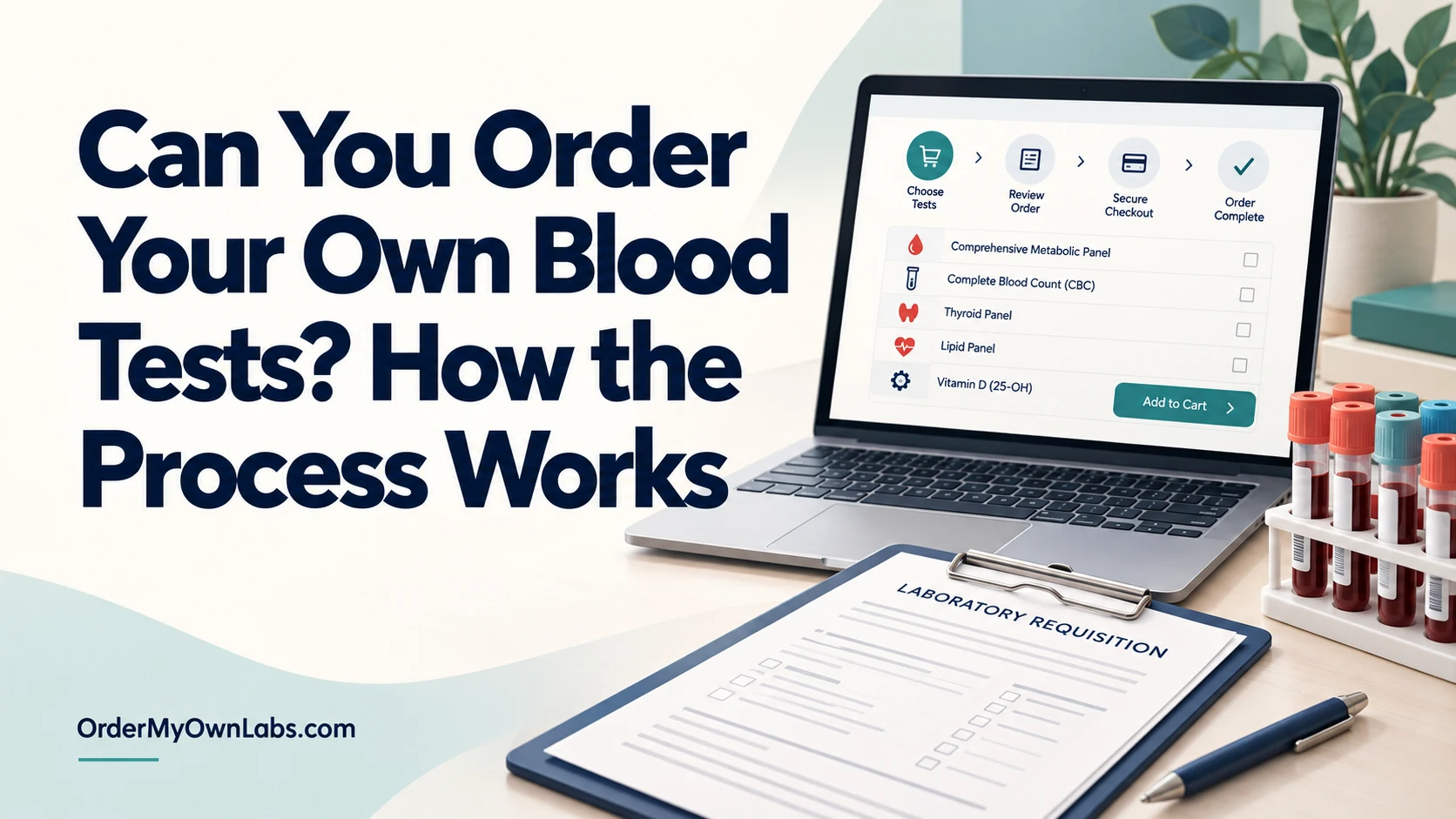
    Can You Order Your Own Blood Tests? How the Process Works — illustration of laptop lab order form and blood-sample tubes.
    Direct answer

    Yes. In the United States, consumer testing services let eligible adults purchase selected blood tests online without first visiting their own doctor. An authorized healthcare professional may still review and order the testing. Before paying, confirm the exact test, your eligibility, the collection site, the full charge and who will help with results.

    What does ordering blood tests “without a doctor” really mean?

    It usually means you do not need a separate office appointment to ask your usual doctor for a requisition. It does not mean a test is performed without medical oversight. Quest’s consumer purchasing information describes independent provider review. Labcorp OnDemand also says its tests require an authorized professional’s order. Those arrangements are part of the consumer purchase process. [1] [2]

    Keep four roles separate: the business selling the test, the professional authorizing the order, the place collecting the specimen and the laboratory analyzing it. Sometimes the same brand handles several roles. Sometimes a third-party seller arranges a draw through a larger laboratory network.

    OrderMyOwnLabs is an educational and referral website. You do not buy a lab order, submit a sample or receive laboratory results from us. Our purpose is to help you understand what you are comparing before you choose a provider.

    Which ordering route fits your situation?

    RouteHow it beginsWhat to establish first
    Your own clinicianA clinician evaluates your question and orders tests.Whether the laboratory is in your insurance network and what you may owe.
    Laboratory consumer serviceYou select an eligible product through a service such as Quest Health or Labcorp OnDemand.Included oversight, self-pay terms, patient eligibility and approved collection.
    Independent online sellerA separate company sells testing that uses a specified collection/laboratory network.Who issues the order, which network accepts it and which business handles questions.

    These routes may lead to the same laboratory building while having different prices, refund terms and support. A price from one route does not establish what another route will charge. If you already have an order, ask whether using it is more appropriate before buying another.

    What should you do before purchasing?

    1. Name the question. Are you checking an established condition, clarifying a prior result or investigating a symptom? A clinician can help decide whether a test will change your next step.
    2. Copy the exact product name and included measurements. A CBC, CMP and thyroid panel answer different questions. “Complete” is a product description, not a standardized promise that everything is included.
    3. Check patient and location eligibility. Confirm age, residence, collection state and any product-specific restrictions. Do this again for a minor or someone other than yourself.
    4. Locate an authorized collection site. Confirm it handles that requisition and specimen before you pay.
    5. Read the full order summary. Check fees, preparation, expiration, cancellation and results support.

    For example, if your question is about iron stores, check whether a panel actually contains ferritin. Do not buy a CBC assuming it measures iron. Our iron-panel comparison explains why the component list matters.

    Can you use any nearby Quest or Labcorp location?

    Confirm the exact site through your seller’s instructions. A laboratory location finder shows where a business operates; it does not prove that every listed site can complete every order. Your requisition may specify a particular network or collection arrangement.

    Before traveling, ask whether an appointment is needed, whether the site accepts your order, what identification to bring and whether any collection-time restrictions apply. A test requiring several timed samples needs a different plan from a single blood draw. An at-home collection kit is also different from a mobile phlebotomist visiting your home.

    Bring the requisition or order identifier requested by the provider, your confirmation and its preparation instructions. If you change cities or collection sites, check whether your existing order can still be used. Walk-In Lab’s instructions, for example, direct customers to the preparation information supplied with their order. [3]

    What is the full cost, and can insurance pay?

    Compare the amount due for the actual order. Ask whether the listed price includes blood collection, the clinician’s order and the result discussion. Quest describes a product-dependent physician service fee; check the product page and cart rather than assuming a single fee applies to every order. [4]

    Labcorp describes OnDemand as a direct purchase that does not bill your insurance company. [5] That is different from an order your clinician sends to a laboratory for insurance billing. If you have coverage, ask your insurer about the clinician-ordered route before concluding that self-pay is less expensive.

    HSA or FSA card acceptance is a separate question from insurance billing. Confirm the particular purchase with the seller and your plan administrator and keep an itemized receipt. Also ask about unused-order refunds, expiration and what happens if collection cannot be completed.

    Use our full-cost checklist to record the product price, stated fees and unresolved charges. An attractive search-result price is not a final quote for you.

    How do you prepare, and what if you accidentally eat?

    Follow the instructions for your complete order. Some tests require fasting; others do not. MedlinePlus explains that fasting commonly means 8–12 hours with plain water allowed, but the test-specific directions control. Ask about prescription medicines, supplements and anything that could affect your ability to fast safely. [6]

    Do not stop prescribed treatment simply to obtain a preferred number. If you take insulin or another medicine that can lower blood sugar, arrange a fasting plan with your clinician. If you eat, drink coffee or otherwise depart from the instructions, tell the collection team before the draw. Ask whether to proceed or reschedule.

    A practical preparation note can be short: order name, appointment time, fasting start time if required, permitted drinks, medication instructions and the number to call with questions.

    Who explains results, and what happens if something is abnormal?

    Before purchasing, ask how you will receive the report and what support comes with it. Is a clinician discussion included, optional or separately billed? Who contacts you about a critical result? How quickly should you expect a reply? A general customer-service number and a clinical consultation are different services.

    Download the full report, including units, reference intervals and laboratory comments. Share it with the clinician who knows your history. A result flagged high or low needs context; a result within range does not rule out every reason for symptoms.

    If you are buying testing because you feel unwell, make a care plan as well as a purchasing plan. New chest pain, severe trouble breathing, fainting or stroke-like symptoms need urgent evaluation rather than an online test order.

    Common questions before you place an order

    Can I buy a test for my child or another adult?

    Check the specific service’s patient and purchaser rules. Do not assume that an adult account, gift purchase or nearby pediatric collection site makes every product eligible. Ask how consent, identification and report access will work before paying.

    Can I take a Quest order to Labcorp?

    Ask whoever issued the requisition. Treat the named collection network as part of the order; do not assume laboratories will transfer a prepaid order or honor another seller’s payment.

    Should I buy the largest panel?

    Start with the measurements that answer your question. Compare the component lists with existing results and orders to avoid paying for overlap. The test directory and Quest vs Labcorp guide can help you prepare that comparison.

    Sources and editorial information

    Sources and public provider listings checked October 27, 2026. Prepared with AI-assisted research and editorial checks. No independent clinical review is claimed. Provider examples are informational; prices, eligibility and services can change.

    1. Quest: purchasing a test
    2. Labcorp OnDemand: ordering and results
    3. Walk-In Lab: how it works
    4. Quest: physician service fee
    5. Labcorp: consumer self-pay route
    6. MedlinePlus: fasting for a blood test

    Suggest a correction · Our editorial standards · Affiliate disclosure

    Medical disclaimer

    OrderMyOwnLabs.com provides independent educational information, not personal medical advice, diagnosis or treatment. A qualified healthcare professional should help select tests and interpret results. We do not collect samples, issue lab orders or deliver results. Follow the actual provider’s instructions.