Author: admin

  • Lipoprotein(a) Test Cost: What to Compare Before Ordering

    Lipoprotein(a) Test Cost: What to Compare Before Ordering

    Educational guide

    Lipoprotein(a) Test Cost: What to Compare Before Ordering

    By Order My Own Labs · Updated October 27, 2026
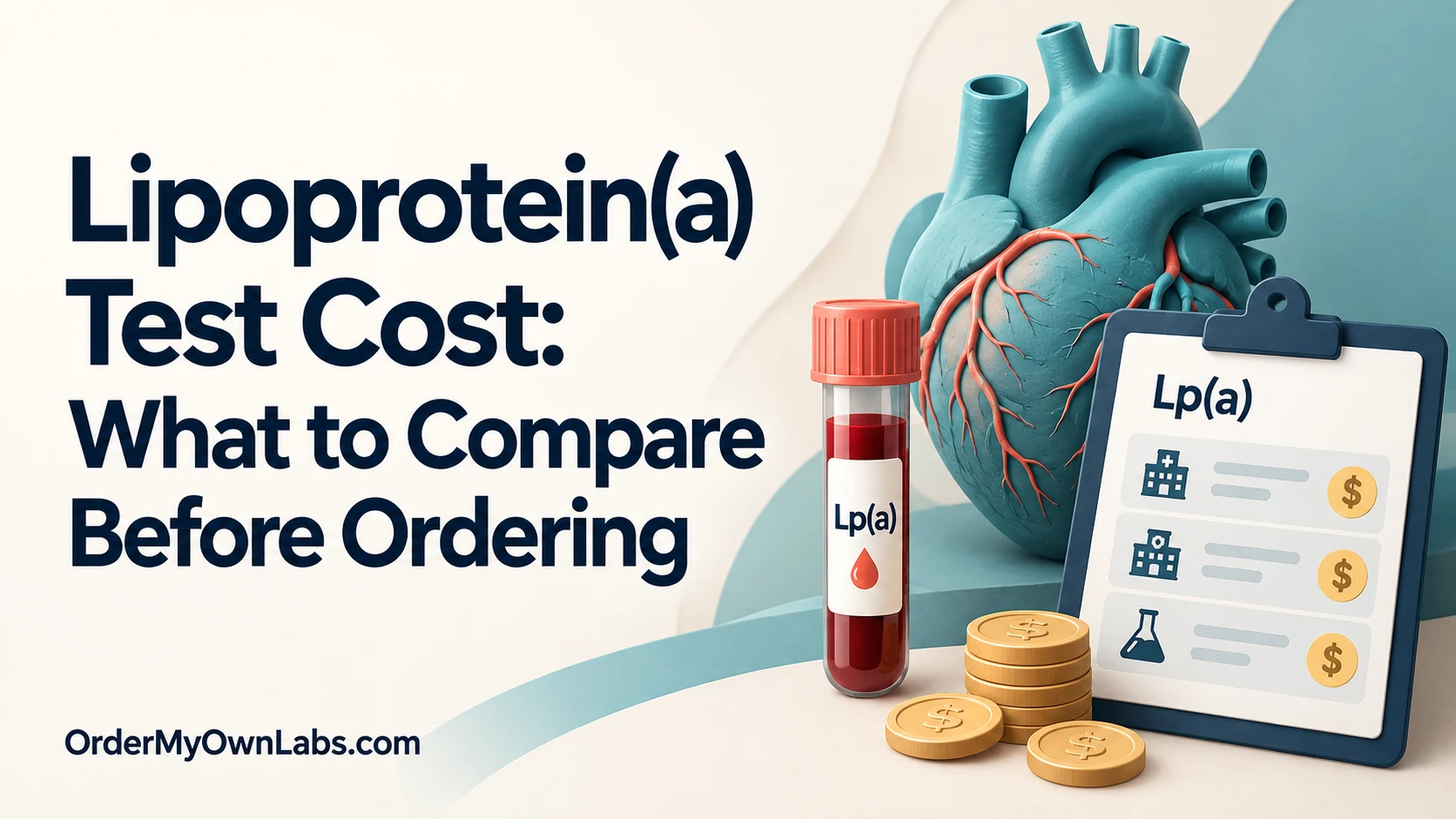
    Lipoprotein(a) Test Cost: What to Compare Before Ordering — illustration of heart model, Lp(a) sample and cost comparison.
    Direct answer

    In the provider examples checked for this guide, standalone Lp(a) listings were $45 or $49 plus a stated $6 physician fee: $51 or $55 before any other applicable charges. A larger heart panel containing Lp(a) was $215 plus $6. These are dated public-listing examples, not a lowest-price claim or a completed checkout quote.

    How much does a lipoprotein(a) test cost?

    The useful comparison is the full price for Lp(a) alone versus the full price for a panel you actually need. Public listings checked October 27, 2026 showed the following. Promotional coupon prices have been left out so a temporary offer is not mistaken for the ordinary listing.

    Public product listingListed priceStated added feePrice plus stated fee
    Walk-In Lab: Cardio IQ Lipoprotein(a) [1]$45$6 per order$51
    Walk-In Lab: Lipoprotein(a) [2]$49$6 per order$55
    Quest: Advanced Heart Health panel with ApoB, including Lp(a) [3]$215$6 physician service fee$221

    The arithmetic above includes only the charges explicitly shown in those public listings. No account-specific checkout, zip-code eligibility or optional collection service was purchased or verified. Confirm the current total, laboratory option and eligibility before paying. These examples are not an exhaustive market survey, and the two standalone offers are from the same seller.

    If your clinician wants only Lp(a), compare standalone offers first. If several markers are needed, compare the exact bundle with the cost of the relevant individual tests. Avoid paying for a panel because “advanced” sounds like a more accurate version of Lp(a).

    What is Lp(a), and why might it matter?

    Lipoprotein(a), usually written Lp(a), is an LDL-like particle with an additional protein called apolipoprotein(a). Its level is largely inherited. It supplies cardiovascular risk information that a routine cholesterol panel may not capture. An Lp(a) blood test is different from LDL cholesterol, ApoB and a genetic DNA test. [4]

    Importantly, the March 2026 ACC/AHA dyslipidemia guidance recommends measuring Lp(a) at least once in adulthood. [5] That is broader than older patient resources describing testing mainly in selected higher-risk people. A current guide should acknowledge the newer recommendation without implying that a result is a diagnosis or a treatment plan.

    Ask how the result will be incorporated into your overall risk assessment. Family history, other lipid results, blood pressure and relevant medical conditions still matter.

    Is Lp(a) included in a standard lipid panel?

    Do not assume it is. Look for an explicit “lipoprotein(a)” entry in the product’s component list. Total cholesterol, LDL cholesterol, HDL cholesterol and triglycerides do not establish that an Lp(a) measurement is included. [4]

    The distinction also applies to advanced packages. A heart panel can contain ApoB or an inflammation marker without containing Lp(a). Search the actual list, not just the title, and ask the seller if it is unclear.

    Our lipid-panel comparison provides background. The ApoB cost guide addresses a different measurement; ordering ApoB is not a substitute for an explicitly requested Lp(a) result.

    What should you compare besides the advertised price?

    • Exact measurement: Lp(a) alone, or a named panel containing it?
    • Laboratory and collection: Which network accepts the requisition, and where can you use it?
    • Reporting: What units will appear on the report, and is a sample report available?
    • Fees: Which charges apply once per order, and which depend on collection?
    • Preparation: What instructions apply to the complete order?
    • Support: Who discusses an abnormal result and the next step?

    For a clinician-ordered test, also ask about insurance and your expected out-of-pocket share. A consumer cash price is not proof of what insurance will cover, and an insurance estimate is not the same as a prepaid self-pay purchase.

    Record the date you checked each offer. Save the product description and order summary so you can later confirm that the report matches what you intended to buy.

    Do you need to fast for an Lp(a) test?

    The standalone Walk-In Lab Lp(a) listing checked here stated no special preparation. [2] That instruction belongs to that particular offer. A combined panel can have different directions: the Quest panel in the table recommended an 8–12-hour fast. [3]

    Use the instructions for your complete order. If you add fasting glucose or another test, ask whether preparation changes. Do not extend a fast or stop prescribed medicine to try to alter Lp(a). Tell the ordering clinician about your medicines and any relevant recent illness.

    Before booking, confirm whether the test is a standard laboratory draw, a home collection kit or an optional mobile visit. Those arrangements can have different availability and charges.

    How should you read nmol/L and mg/dL?

    Keep the reported unit attached to the result. A bare number copied into a message is incomplete. The National Lipid Association presents Lp(a) risk categories in nmol/L and mg/dL and stresses that risk exists on a continuum. [6]

    For example, “50” without a unit is not enough information for a comparison. Do not compare the numerical value of one unit directly with a threshold written in another unit. If older and newer reports use different units, ask your clinician or laboratory how to compare them rather than assuming a universal conversion.

    The NLA’s update describes high-risk levels as at least 125 nmol/L or at least 50 mg/dL. [6] These are risk categories, not proof of an artery blockage or a prediction that a heart attack will occur. Your clinician should place the result in the full cardiovascular picture.

    Do you need to repeat Lp(a) regularly?

    Because levels are largely genetically determined and relatively stable, the 2026 ACC/AHA summary says repeat testing is generally unnecessary. [5] “Generally” is important: ask your clinician whether your circumstances create a reason to repeat, rather than buying a recurring test solely because it is offered.

    If you already have an Lp(a) report, bring it before purchasing another test. Check that it is truly Lp(a), that the units are visible and that the report belongs to you. A prior routine lipid panel without Lp(a) does not answer that question.

    Do not interpret “once in adulthood” as a promise that no one will ever need another measurement. It is a reason to have a clear purpose for a repeat order.

    What should you do with a high result?

    Arrange a discussion about your overall cardiovascular risk and prevention plan. Ask whether the finding changes the approach to LDL cholesterol or other risks and whether family members should discuss testing. NLA guidance supports screening first-degree relatives when Lp(a) is elevated. [6]

    A high result is not an emergency diagnosis by itself, and a low result is not an all-clear for every heart condition. New chest pain or stroke-like symptoms require urgent care, regardless of your Lp(a) result.

    Is the cheapest listing always the best choice?

    A lower price is useful only if the order fits your location, preparation needs and follow-up plan. Compare the complete cost and use the ordering guide to understand who is responsible at each step.

    Sources and editorial information

    Sources and public provider listings checked October 27, 2026. Prepared with AI-assisted research and editorial checks. No independent clinical review is claimed. Provider examples are informational; prices, eligibility and services can change.

    1. Walk-In Lab: Cardio IQ Lp(a) listing
    2. Walk-In Lab: Lp(a) listing and preparation
    3. Quest: Advanced Heart Health panel listing
    4. MedlinePlus: lipoprotein(a) blood test
    5. ACC/AHA: March 2026 dyslipidemia guidance
    6. National Lipid Association: 2024 focused Lp(a) update

    Suggest a correction · Our editorial standards · Affiliate disclosure

    Medical disclaimer

    OrderMyOwnLabs.com provides independent educational information, not personal medical advice, diagnosis or treatment. A qualified healthcare professional should help select tests and interpret results. We do not collect samples, issue lab orders or deliver results. Follow the actual provider’s instructions.
  • Blood Tests for Insulin Resistance: How the Options Differ

    Blood Tests for Insulin Resistance: How the Options Differ

    Educational guide

    Blood Tests for Insulin Resistance: How the Options Differ

    By Order My Own Labs · Updated October 27, 2026

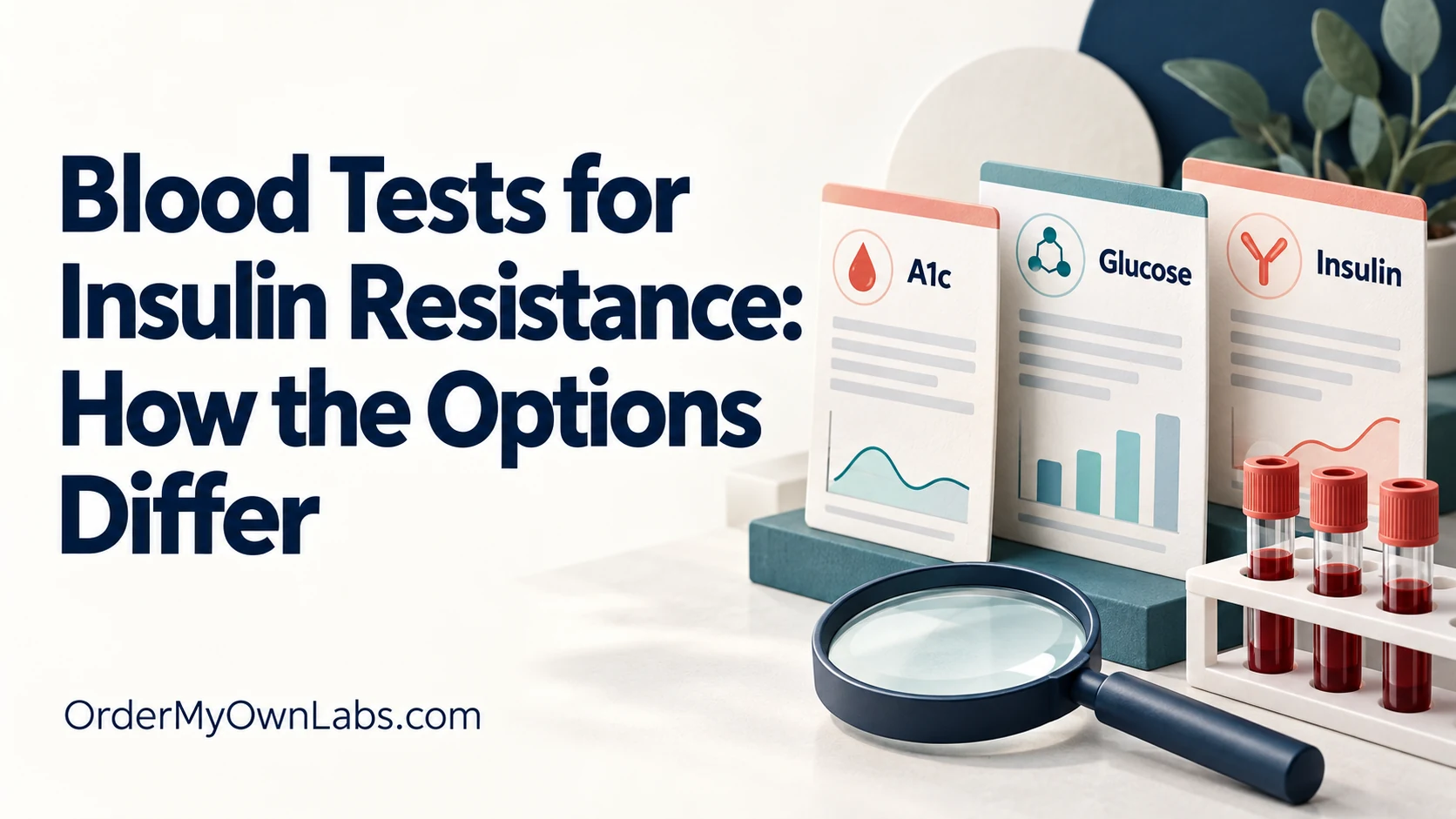
    Blood Tests for Insulin Resistance: How the Options Differ — illustration of A1c, glucose and insulin comparison cards.
    Direct answer

    There is no single routine blood test that answers every question about insulin resistance. A1c, fasting glucose and oral glucose tolerance testing identify abnormal glucose regulation. Fasting insulin, C-peptide and calculated scores provide different information and have different limitations. Choose testing around the clinical question, rather than treating all “insulin resistance” products as interchangeable.

    Are insulin resistance and prediabetes the same thing?

    They are related, but they are different concepts. Insulin resistance means the body’s cells respond less effectively to insulin. Prediabetes means blood glucose is above the normal range but below the diabetes threshold. A person’s glucose result therefore does not directly measure how responsive every tissue is to insulin.

    NIDDK explains that direct testing for insulin resistance is mainly used in research. In ordinary care, clinicians consider history and risk factors and use established glucose tests to identify prediabetes. [1] This distinction matters when a product page offers an “insulin resistance score.” A commercially available estimate is not automatically the same as an established diabetes diagnostic test.

    Before choosing a panel, finish this sentence: “I want the result to help decide whether…” Examples include whether a prior glucose result needs confirmation, whether a medication plan needs review, or whether additional risk assessment would change care.

    Which tests answer which questions?

    TestMain informationImportant limitation
    A1cAverage glucose exposure over about three months.Some blood and health conditions affect its relationship to glucose.
    Fasting plasma glucoseGlucose after the instructed fast.One time point; it does not directly measure insulin sensitivity.
    Oral glucose tolerance testGlucose response after a standardized glucose drink.Requires a timed collection protocol; a random post-meal test is different.
    Fasting insulinCirculating insulin during the fasting sample.Not a stand-alone universal diagnosis of insulin resistance.
    C-peptideInformation about the body’s own insulin production.Requires interpretation with glucose and the clinical situation.
    Calculated or branded scoreAn estimate based on specified measured inputs.Use the method’s own validation and eligibility rules.

    These are complementary questions, not a ladder in which the most expensive test is always best. Bring existing reports to the appointment so the discussion begins with what is already known.

    What do the established prediabetes results mean?

    NIDDK lists adult prediabetes ranges of A1c 5.7%–6.4%, fasting plasma glucose 100–125 mg/dL and two-hour oral glucose tolerance test glucose 140–199 mg/dL. [1] These ranges describe glucose regulation; they are not fasting insulin or HOMA-IR cutoffs.

    A clinician should interpret the result, decide whether confirmation is needed and consider reasons tests disagree. Pregnancy uses different testing pathways. Do not use a home meter value or a nonstandard meal challenge as if it were the laboratory protocol.

    If A1c and glucose seem inconsistent, ask about the timing of collection, preparation and conditions that can affect A1c. Our A1c guide explains why the complete history matters. The next step should resolve the uncertainty rather than simply add every available test.

    What can fasting insulin and C-peptide add?

    They can help a clinician examine insulin production in selected circumstances. C-peptide is released when the pancreas makes insulin, while injected insulin does not contain it. Insulin testing may be used when investigating abnormal glucose patterns, including low glucose. [2]

    Neither result should be read as an isolated health grade. Ask which glucose result should be considered alongside it, whether medicines affect interpretation and whether the laboratory method matters for your situation.

    For ordering purposes, make the product list explicit. “Insulin” alone does not promise that glucose or C-peptide is included. Our fasting insulin guide covers the single-test preparation and reporting questions in more detail.

    What is HOMA-IR, and is it a separate blood draw?

    HOMA refers to a mathematical model using fasting measurements to estimate aspects of insulin sensitivity and beta-cell function. Oxford’s description distinguishes the model from other techniques used to assess these processes. HOMA2 is an updated model, so outputs from different versions should not be treated as interchangeable. [3]

    A HOMA-IR estimate is usually calculated from specified laboratory inputs; it is not a new substance measured in a tube. Before paying for one, ask which model is being used, which inputs are required, whether they must come from the same fasting collection and which units are expected.

    An online calculator can return a precise-looking number even when the wrong units, nonfasting samples or inappropriate inputs are used. Ask your clinician whether the calculation is appropriate and what threshold has been validated for the relevant setting. This guide does not assign a universal “optimal” HOMA-IR target or provide a self-diagnosis calculator.

    How do commercial insulin-resistance panels differ?

    Quest’s consumer panel lists intact insulin, C-peptide and its own calculated insulin resistance score. It also identifies product-specific suitability limits. [4] Labcorp’s Complete Heart Health Test includes a Diabetes Risk Index along with lipids, ApoB and GlycA. [5] Those are different packages and scoring approaches.

    A score’s name does not tell you its inputs, evidence or intended population. Ask the provider for those details. In particular, check whether diagnosed diabetes, kidney disease or treatment affects eligibility or interpretation.

    Do not compare a HOMA-IR value with a branded panel’s score as though both use the same scale. Save the report’s explanation and method, not just the final number. If a clinician is already following one measure, ask before replacing it with a differently named commercial score.

    How do you prepare and avoid unnecessary spending?

    Obtain the instructions for the complete order before collection. Fasting insulin, fasting glucose and a glucose tolerance test have different protocols; A1c alone generally does not require fasting. Follow the actual order and ask about medicine timing. [2] [6]

    Prepare a comparison sheet with five fields: included tests, purpose, collection requirements, full charge and follow-up support. Mark anything unresolved. A broad heart panel may include a metabolic score while omitting the particular glucose measurement your clinician wants.

    Compare the proposed tests with recent results. Ask what would be done differently after a normal, borderline or clearly abnormal finding. If the answer is the same regardless of the result, discuss whether that test adds useful information now.

    What if glucose is normal but you still have concerns?

    Bring your family history, prior results, medicines and specific concerns to a qualified clinician. Normal glucose results do not answer every metabolic question, but they are also not evidence that a hidden problem must be found through a larger panel.

    For an appointment, note changes in weight, thirst, urination or energy without deciding their cause in advance. Symptoms can have more than one explanation. Testing should support an evaluation rather than replace it.

    Can I monitor progress by repeating every test monthly?

    Ask which measure is meaningful for the care plan and how much time it needs to change. A schedule should follow the condition and treatment, not a subscription interval alone.

    What should I order first?

    There is no personal first-test recommendation in a general article. Use the comparison above with your clinician and review the glucose guide and cost checklist before purchasing.

    Sources and editorial information

    Sources and public provider listings checked October 27, 2026. Prepared with AI-assisted research and editorial checks. No independent clinical review is claimed. Provider examples are informational; prices, eligibility and services can change.

    1. NIDDK: insulin resistance and prediabetes
    2. MedlinePlus: insulin and C-peptide context
    3. University of Oxford: HOMA model
    4. Quest: insulin resistance panel
    5. Labcorp: Complete Heart Health Test
    6. MedlinePlus: fasting instructions

    Suggest a correction · Our editorial standards · Affiliate disclosure

    Medical disclaimer

    OrderMyOwnLabs.com provides independent educational information, not personal medical advice, diagnosis or treatment. A qualified healthcare professional should help select tests and interpret results. We do not collect samples, issue lab orders or deliver results. Follow the actual provider’s instructions.
  • CRP vs hs-CRP: Which Test Name Matches Your Question?

    CRP vs hs-CRP: Which Test Name Matches Your Question?

    Educational guide

    CRP vs hs-CRP: Which Test Name Matches Your Question?

    By Order My Own Labs · Updated October 27, 2026

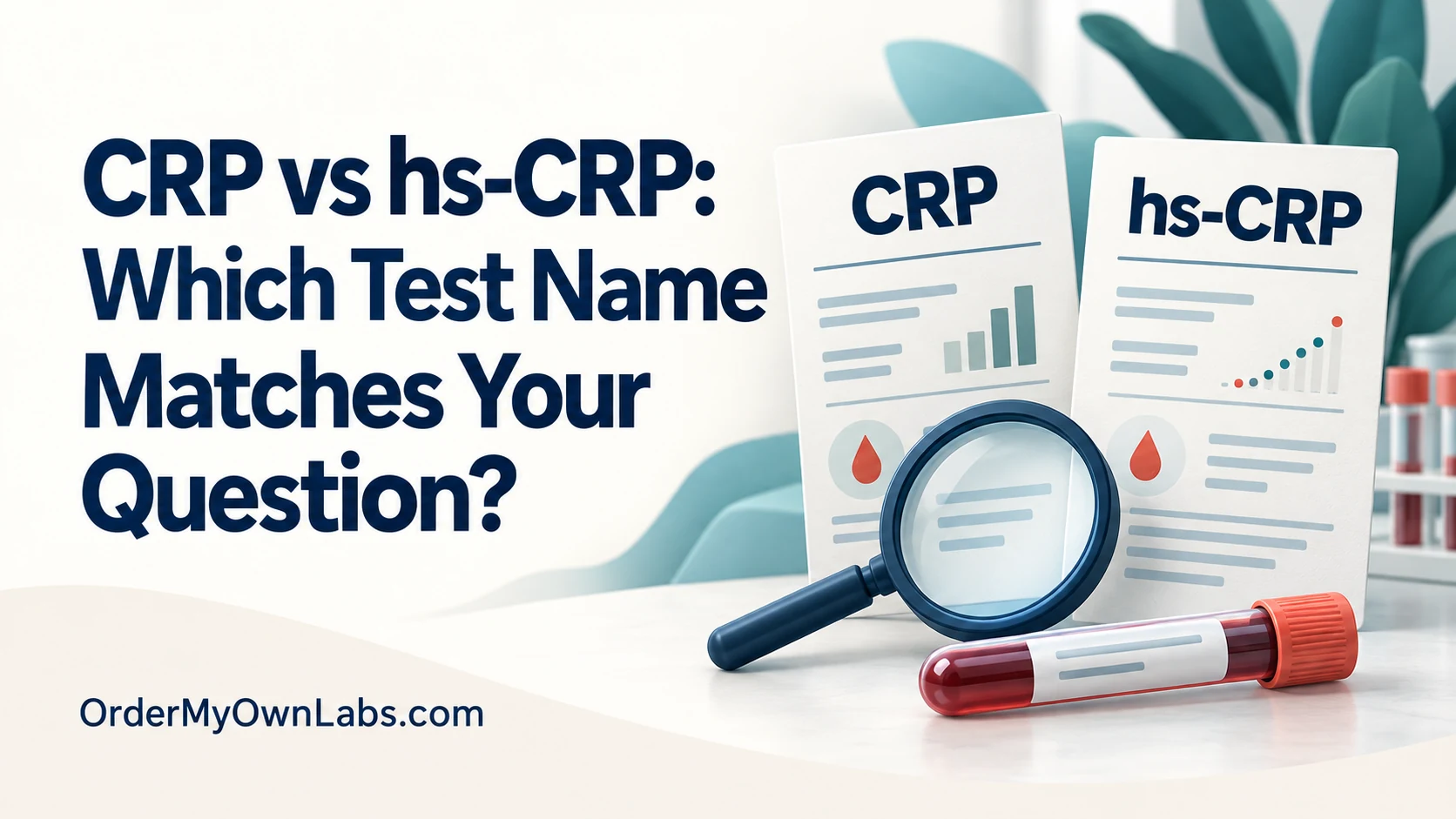
    CRP vs hs-CRP: Which Test Name Matches Your Question? — illustration of CRP and hs-CRP laboratory comparison cards.
    Direct answer

    CRP and hs-CRP measure the same protein, C-reactive protein. The difference is the assay’s sensitivity and intended use. Standard CRP helps assess inflammation; hs-CRP can measure lower concentrations used in cardiovascular risk assessment. Neither result identifies the cause of inflammation or diagnoses blocked arteries by itself.

    What is the difference between CRP and hs-CRP?

    Your liver makes C-reactive protein in response to inflammation. A standard CRP test helps clinicians assess or monitor inflammatory activity. A high-sensitivity CRP assay can detect lower concentrations and is used for a different clinical question, often cardiovascular risk. [1] [2]

    “High sensitivity” does not mean you have more severe inflammation, and it does not mean a different protein is being measured. It describes the measurement approach. The test name matters because the report must be interpreted for the purpose of the order.

    FeatureStandard CRPHigh-sensitivity CRP
    Protein measuredC-reactive protein.C-reactive protein.
    Common purposeAssessing or following inflammatory activity.Adding inflammation-related information to cardiovascular risk assessment.
    What to confirmExact assay and laboratory reference interval.Explicit hs-CRP or high-sensitivity name and intended use.
    What it cannot identify aloneThe specific cause or location of inflammation.An artery blockage, an impending heart attack or the full cardiovascular risk picture.

    If a clinician requested one assay, confirm before substituting the other. An online seller’s general “inflammation” category is not specific enough.

    Which test name should you look for when ordering?

    Copy the requested name from the clinician’s order or care plan. For a cardiovascular question, look for “high-sensitivity C-reactive protein,” “hs-CRP,” or a clearly documented equivalent on the product page. For monitoring an inflammatory condition, ask which standard CRP method and interval your clinician wants to follow.

    A package title such as “heart panel” is not enough evidence that hs-CRP is included. Read the component list. Likewise, ApoB, Lp(a) and other markers do not substitute for CRP. They answer different questions.

    If the seller only says “CRP,” contact it before paying. Ask for the exact test code, laboratory and assay name. This small check is easier than trying to interpret the wrong test afterward.

    Can either test tell you why inflammation is present?

    No. CRP can rise with infection, injury and inflammatory disease, but the value does not locate the problem or identify its cause. Clinicians interpret it alongside symptoms, examination and other findings. [1]

    A high value is not a stand-alone diagnosis of an autoimmune disease or an infection requiring antibiotics. A low value is also not a complete explanation for persistent symptoms. Testing should answer a defined clinical question.

    Before the draw, note recent illness, injuries, surgery or other relevant changes and tell the ordering clinician. That context can help determine whether the timing is suitable and whether a repeat would be informative.

    How are hs-CRP results used for heart-risk assessment?

    Mayo Clinic’s patient guidance describes hs-CRP below 2.0 mg/L as lower risk and 2.0 mg/L or higher as higher risk in this context. It also emphasizes that hs-CRP is only one risk factor and varies over time. [3]

    That threshold does not mean “no heart disease” below it or “heart disease diagnosed” above it. A prevention discussion also considers blood pressure, lipids, smoking, diabetes, family history and other relevant factors.

    For example, a person with a recent illness and an elevated hs-CRP needs a discussion about timing and context. The appropriate response is not to treat the number as a permanent cardiovascular risk label. Ask what the result changes and whether confirmation is useful.

    Our lipid-test comparison explains related measurements. Do not buy several markers merely to replace a proper cardiovascular evaluation.

    What do mg/L and mg/dL mean?

    They are concentration units, and the difference matters. One mg/dL equals 10 mg/L. A result of 0.3 mg/dL therefore equals 3 mg/L, not 0.3 mg/L. This is a unit conversion, not a change in the amount of inflammation.

    Before comparing two reports, confirm the exact assay, units and reference intervals on both. A result labeled only “CRP 3” is incomplete. Keep the report rather than copying a number without its context.

    Do not apply an hs-CRP cardiovascular category to an unspecified CRP result because the units happen to match. The intended assay and reason for testing still matter. If you are unsure which was performed, ask the laboratory or ordering professional.

    Should you test while you are sick or after hard exercise?

    Tell the clinician if you are ill or have recently done unusually strenuous exercise. Mayo Clinic notes that intense exercise can affect CRP and that hs-CRP risk assessment may use two samples about two weeks apart. [3] Your clinician should decide the timing and whether a repeat is appropriate.

    If the purpose is to investigate illness, postponing solely to get a lower value could defeat that purpose. If the purpose is cardiovascular risk assessment, a temporary inflammatory event may complicate interpretation. The same circumstance can therefore lead to different collection decisions depending on the clinical question.

    Do not postpone evaluation of a concerning symptom while waiting for a “clean” testing day. New chest pain, severe breathing trouble or stroke-like symptoms require urgent care, regardless of a prior CRP or hs-CRP result.

    Do CRP and hs-CRP require fasting?

    CRP testing alone often needs little preparation. Other tests in the same order can require fasting, and medicines or supplements may affect the overall testing plan. Mayo Clinic advises following the healthcare professional’s preparation instructions. [3]

    Ask for one clear set of instructions for the complete order. Include whether plain water is allowed, whether exercise should be limited and how to handle medicines. Do not stop prescriptions or start supplements to change the result before collection.

    If you accidentally eat before a fasting panel that includes hs-CRP, tell the collection team. The question is whether the complete order can still be used as intended, not simply whether CRP itself requires fasting.

    How should you compare cost and follow-up?

    Compare the same assay as a standalone order and inside any proposed bundle. Write down the product name, included measurements, laboratory, collection site, public price, stated fees and what remains uncertain. Our cost checklist can help.

    Ask whether a repeat, if advised, is a separate purchase. Also confirm who reviews the report and how you can obtain clinical guidance. A customer-service representative can explain an order but may not be able to interpret a medical result.

    Does “cardiac CRP” mean hs-CRP?

    It may be used as a product label, but confirm the laboratory’s exact high-sensitivity assay before purchasing.

    Should I order both standard CRP and hs-CRP?

    Ask whether two orders would answer different questions in your situation. They measure the same protein, so buying both without a clear purpose can add expense without resolving uncertainty.

    What should I bring to a result discussion?

    The full report, why the test was ordered, relevant symptoms, recent illness or exertion, medicines and prior results. That creates a useful discussion about the next step.

    Sources and editorial information

    Sources and public provider listings checked October 27, 2026. Prepared with AI-assisted research and editorial checks. No independent clinical review is claimed. Provider examples are informational; prices, eligibility and services can change.

    1. MedlinePlus: C-reactive protein test
    2. MedlinePlus: CRP and the high-sensitivity assay
    3. Mayo Clinic: CRP and hs-CRP preparation and interpretation

    Suggest a correction · Our editorial standards · Affiliate disclosure

    Medical disclaimer

    OrderMyOwnLabs.com provides independent educational information, not personal medical advice, diagnosis or treatment. A qualified healthcare professional should help select tests and interpret results. We do not collect samples, issue lab orders or deliver results. Follow the actual provider’s instructions.
  • ApoB Test Cost: Standalone Tests Versus Heart Health Panels

    ApoB Test Cost: Standalone Tests Versus Heart Health Panels

    Educational guide

    ApoB Test Cost: Standalone Tests Versus Heart Health Panels

    By Order My Own Labs · Updated October 27, 2026

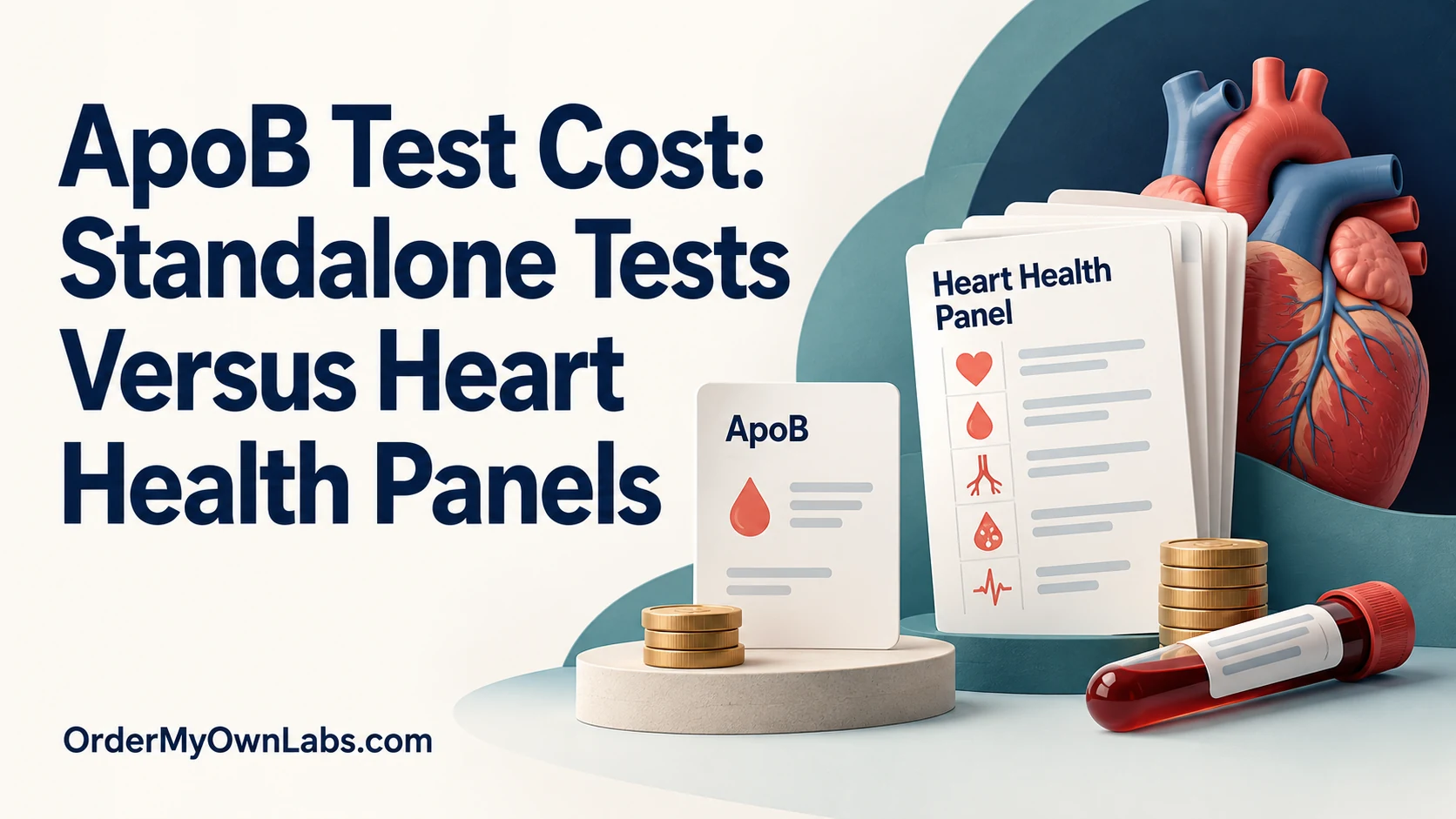
    ApoB Test Cost: Standalone Tests Versus Heart Health Panels — illustration of ApoB-only card beside a heart-health panel.
    Direct answer

    ApoB-only testing and heart-health bundles have different prices because they contain different measurements. In public listings checked for this guide, an ApoB-only offer was $59 plus a $6 physician fee. Two broader panels were listed at $169 and $215 plus $6, respectively. Compare exact contents and current final charges before choosing.

    How much does an ApoB test cost without insurance?

    The following are public-listing examples checked October 27, 2026. They are a small comparison of standalone versus bundled testing, not a claim to have found the cheapest ApoB test nationwide. Coupon discounts are excluded.

    OfferWhat you are buyingPublic price and stated fee
    Walk-In Lab: Apolipoprotein B [1]ApoB-only test.$59 + $6 physician fee = $65
    Labcorp OnDemand: Complete Heart Health with ApoB [2]ApoB with lipids, GlycA and Diabetes Risk Index.$169 listed; confirm final order summary
    Quest: Advanced Heart Health with ApoB [3]ApoB with lipids, Lp(a), hs-CRP and Lp-PLA2 activity.$215 + $6 physician fee = $221

    These packages are not equivalent. A lower price for the first row reflects a narrower order; the two bundles also differ from each other. The table includes only publicly stated prices and fees. It does not establish a personalized checkout total, eligibility or optional collection charges.

    If you already have recent lipid results and your clinician wants only ApoB, ask whether a standalone order is sufficient. If several measurements are needed, compare the exact useful bundle with the separate tests. Do not count extra markers as value until you know why they are being ordered.

    What does ApoB measure?

    Apolipoprotein B is a protein carried on atherogenic lipoproteins: particles involved in atherosclerotic cardiovascular risk. An ApoB blood test measures its concentration. It provides information related to the number of those particles, whereas LDL cholesterol describes the cholesterol they carry. [4]

    Those quantities can differ in ways that matter clinically. Quest’s test directory notes that ApoB may be elevated in some people even when LDL cholesterol is not. [4] This does not make an ApoB result a direct image of plaque or a stand-alone diagnosis of heart disease.

    For a result discussion, bring the actual ApoB value and unit, your lipid panel and the reason testing was requested. A number detached from the clinical history cannot set your personal treatment goal.

    Who might benefit from discussing an ApoB test?

    The 2026 ACC/AHA guidance identifies selected uses of ApoB to assess remaining cardiovascular risk and help guide care, including certain people with type 2 diabetes, high triglycerides, cardiovascular-kidney-metabolic syndrome or known cardiovascular disease. [5]

    That is a reason for an individualized discussion, not a recommendation that every visitor purchase a bundle. Ask what question remains after your standard lipid results and how ApoB would affect the plan.

    If your clinician is monitoring treatment, ask which target applies to your risk category and when to repeat the test. Do not adopt a target from another person’s report or change a prescription based only on a shopping-site chart.

    Is ApoB included in a routine lipid panel?

    Check the component list for “apolipoprotein B” or “ApoB.” A routine lipid panel’s cholesterol and triglyceride values do not establish that ApoB was measured. A product called “heart health” may or may not include it.

    The same caution applies to a ratio. An ApoB/ApoA1 ratio contains different information from ApoB alone; read whether the individual concentrations are also reported. An LDL particle-number test also uses a different measurement approach. If your clinician requested a named test, confirm substitutions before purchasing.

    Our lipid and advanced-test comparison helps you identify these distinctions. Start with the specific measurement and then compare sellers.

    Are ApoB and lipoprotein(a) the same test?

    No. ApoB and Lp(a) are separately named measurements on an order. Seeing ApoB in a package does not establish that a separate Lp(a) result will be provided. The Quest example above contains both; that does not make every ApoB panel a combined order.

    If your clinical question includes Lp(a), find that exact entry in the product description. Use our Lp(a) cost guide for a focused comparison. Adding a second measurement to a cart should be a deliberate choice, not an attempt to make a panel feel more complete.

    Do you need to fast for ApoB?

    Follow the actual purchased order rather than a general answer about ApoB. The Walk-In Lab ApoB listing checked here required 12–14 hours of fasting. Labcorp’s named bundle also specified 12–14 hours, while Quest’s named bundle recommended 8–12 hours. [1] [2] [3]

    Those examples illustrate why one article’s blanket preparation instruction can be misleading. A laboratory’s protocol and the other tests in a panel matter. Ask the provider to resolve conflicting instructions before collection.

    Plain water is usually permitted for fasting blood tests, but check your instructions. Discuss medication timing with your clinician and do not stop prescribed treatment to prepare on your own. If you cannot fast safely, ask about an appropriate alternative plan.

    What fees, turnaround and support should you verify?

    Keep a brief order worksheet. Record the current product price, physician or collection fee, authorized draw site, preparation, expected reporting window and included clinical support. Ask whether an added test creates another order fee and whether an optional home visit is separate.

    A turnaround estimate should identify when the clock starts: at collection, laboratory receipt or completion of all panel components. A bundle may release different results at different times. Do not schedule a clinical review around a general brand-wide promise without checking the particular test.

    For self-pay, save the receipt and itemized description. For insurance, ask your clinician, laboratory and insurer about the relevant route and expected responsibility. A cash price does not predict coverage or reimbursement.

    How should you use the result?

    Discuss ApoB together with your other lipid results, history and prevention plan. Ask whether it adds information that changes care and how any follow-up will be evaluated. A laboratory’s reference interval and an individualized treatment target are not necessarily the same thing.

    For repeated measurements, keep the report’s laboratory, method where supplied, units and collection conditions. Ask whether consistency of laboratory and preparation would make the comparison more useful. Do not interpret a small numerical change without considering context.

    Can a normal ApoB result rule out heart disease?

    No single blood result provides that guarantee. Testing contributes to risk assessment; symptoms and clinical findings require their own evaluation.

    Should I purchase the largest heart panel?

    Only after deciding which measurements are useful. Compare the exact order with existing results, then use the full-cost checklist. The decision should be understandable before you pay.

    Sources and editorial information

    Sources and public provider listings checked October 27, 2026. Prepared with AI-assisted research and editorial checks. No independent clinical review is claimed. Provider examples are informational; prices, eligibility and services can change.

    1. Walk-In Lab: ApoB listing and preparation
    2. Labcorp: Complete Heart Health with ApoB
    3. Quest: Advanced Heart Health with ApoB
    4. Quest test directory: apolipoprotein B
    5. ACC/AHA: March 2026 dyslipidemia guidance

    Suggest a correction · Our editorial standards · Affiliate disclosure

    Medical disclaimer

    OrderMyOwnLabs.com provides independent educational information, not personal medical advice, diagnosis or treatment. A qualified healthcare professional should help select tests and interpret results. We do not collect samples, issue lab orders or deliver results. Follow the actual provider’s instructions.
  • Quest vs Labcorp: Comparing Ordering Routes, Tests and Results

    Quest vs Labcorp: Comparing Ordering Routes, Tests and Results

    Educational guide

    Quest vs Labcorp: Comparing Ordering Routes, Tests and Results

    By Order My Own Labs · Updated October 27, 2026

    Quest vs Labcorp: Comparing Ordering Routes, Tests and Results — illustration of Quest and Labcorp comparison cards and ordering laptop.
    Direct answer

    Choose between Quest and Labcorp by comparing the exact test, ordering route, authorized local collection, full cost and result support. Neither brand is a universal winner for every test or patient. A purchase from a third-party seller can use one of these networks while having different terms from the laboratory’s own consumer service.

    Are you comparing laboratories, consumer stores or resellers?

    These are different comparisons. Quest Diagnostics and Labcorp operate laboratory services. Quest’s consumer purchasing site and Labcorp OnDemand let eligible customers buy selected tests. An independent online seller can also arrange testing through a specified laboratory network.

    Quest describes independent healthcare-provider involvement in its consumer ordering process. Labcorp OnDemand likewise requires an authorized professional’s order through its arrangements. [1] [2] You can avoid a separate visit to obtain a requisition while still having an ordering clinician involved.

    Write down the seller, ordering professional, collection network and performing laboratory for each offer. If you do not know which company you are paying, you cannot reliably compare its cancellation, billing or result-support terms.

    What is the practical side-by-side comparison?

    DecisionQuest routeLabcorp route
    Your clinician already ordered testingCheck the order, network and insurance instructions with the clinician and Quest.Check the order, network and insurance instructions with the clinician and Labcorp.
    Buying directly as a consumerCompare the exact Quest consumer product and its stated fees.Compare the exact Labcorp OnDemand product and its order summary.
    Buying through another sellerConfirm that the requisition is valid for the stated Quest collection site.Confirm that the requisition is valid for the stated Labcorp collection site.
    Choosing a locationVerify the particular site, appointment and specimen requirements.Verify the particular site, appointment and specimen requirements.
    Reading resultsUse the access and clinical-support process supplied with that order.Use the access and clinical-support process supplied with that order.

    The repeated checks are intentional: the network name alone does not resolve them. The strongest choice for you may be the route that provides the required test at a usable location with clear costs and follow-up.

    Is Quest or Labcorp cheaper?

    There is no defensible brand-wide answer from one or two examples. Compare the same measurement set through the same payment route. A bundled panel at one store is not a fair price match for a single marker at another.

    For example, the heart-health products examined in our ApoB cost guide contain different extra markers. Their prices do not establish that either network is cheaper for ApoB alone. Likewise, the word “vitamin” does not identify a standard package.

    Record the price, stated clinician and draw fees, optional services, discounts and final order summary. Keep unresolved charges separate rather than silently counting them as zero. A coupon can change the immediate purchase price without changing which provider is usually less expensive.

    For clinician-ordered testing billed to insurance, confirm network participation and your expected share with the insurer and laboratory. Labcorp’s patient resources distinguish that route from OnDemand self-pay purchases. [3] [4]

    Can you use insurance when you buy your own test?

    Do not assume direct consumer checkout works like presenting an insurance card for a clinician’s order. Labcorp states that OnDemand purchases do not bill your insurance company. [3] For either provider, check the payment terms of the specific route you are considering.

    If coverage is important, ask your clinician whether an appropriate covered order can be sent and ask your insurer which laboratory is in-network. An online cash product may be convenient while remaining separate from that process.

    HSA or FSA payment is also different from insurance billing. Ask about the exact product, documentation and plan requirements. Keep the receipt and order description. Do not interpret a card being accepted as a promise that every expense or reimbursement request will be approved.

    Which has a more convenient collection site?

    Compare the locations you can actually use. Enter your area in each provider’s location finder, then confirm that the site accepts the specific requisition and specimen. Ask about appointment times, walk-in policy, accessibility and any special collection hours. [4] [5]

    A nearby building is not automatically suitable for a timed glucose tolerance test, a pediatric draw or a special specimen. A mobile visit and an at-home kit also have different workflows. Confirm the details before you pay or travel.

    If a third-party seller supplies the order, use that seller’s network instructions. Do not assume you can take a Quest-designated prepaid requisition to Labcorp or transfer a purchase because the appointment times are better.

    Bring the required order information and identification. If plans change, ask whether the order remains valid at a different site rather than purchasing a duplicate immediately.

    Do similarly named panels include the same tests?

    Often the only safe answer is to inspect them line by line. Panel names are starting points, not proof of equivalent contents. A BMP and CMP are different; a CBC is different again. “Complete thyroid” and TSH with reflex testing can also represent different workflows.

    Use a component checklist. Mark each measured test, calculated value and conditional follow-up test. If a package lists a large marker count, ask which entries are separate measurements and which are calculations. A higher count is not automatically broader diagnostic usefulness.

    For an iron concern, confirm ferritin explicitly. For a cardiovascular concern, confirm ApoB, Lp(a) or hs-CRP individually when requested. Keep a copy of the product details so you can check the completed report against the intended order.

    Which laboratory is more accurate, and can you compare results over time?

    This guide has not performed a head-to-head analytical study and cannot declare one brand more accurate for every test. Accuracy depends on the specific test method, specimen and intended use. Ask your clinician whether a particular assay or laboratory is important for your question.

    For trends, compare full reports. Check units, reference intervals, collection timing, fasting status and any method notes. Do not assume a number changed clinically just because it is printed differently at another laboratory. Do not assume matching units make two different tests interchangeable.

    When a clinician is following an established result, ask whether using the same laboratory and preparation would make the trend easier to interpret. Save both reports and explain any change in laboratory or collection circumstances.

    How do results, turnaround and support compare?

    Check the expected time for the named test and when that time begins. A general provider-wide estimate is not a guarantee for every specialty assay or panel. Some components may finish earlier than others.

    Labcorp OnDemand describes online access through a Labcorp Patient account. Quest’s consumer resources describe its own order and result process. [1] [2] If you buy through a reseller, confirm the process supplied by that reseller rather than assuming the laboratory’s direct-consumer terms apply.

    Before buying, ask who contacts you about urgent findings, whether clinician discussion is included and what a follow-up appointment costs. Also ask how to correct personal details, obtain a copy and share the report with your regular clinician. Do not send health information to an unrelated comparison website to obtain ordinary customer support.

    How should you make the final choice?

    1. Confirm which test or components you need.
    2. Identify the seller and payment route.
    3. Verify an authorized collection site you can use.
    4. Compare the final charge and cancellation terms.
    5. Read the preparation instructions before booking.
    6. Know how results and clinical follow-up will work.

    Should you cancel an existing order to use a cheaper offer?

    First ask about refund eligibility, expiration and whether the replacement is clinically and logistically equivalent. A lower advertised price may not produce a saving after those differences.

    What if neither route fits?

    Discuss another laboratory or ordering arrangement with your clinician. The goal is the right test and follow-up, not loyalty to a particular logo.

    Use our self-ordering guide and cost checklist to finish the comparison.

    Sources and editorial information

    Sources and public provider listings checked October 27, 2026. Prepared with AI-assisted research and editorial checks. No independent clinical review is claimed. Provider examples are informational; prices, eligibility and services can change.

    1. Quest: consumer purchasing process
    2. Labcorp OnDemand: ordering and result access
    3. Labcorp: direct consumer payment route
    4. Labcorp: patient help, preparation and appointments
    5. Quest: consumer help and location resources

    Suggest a correction · Our editorial standards · Affiliate disclosure

    Medical disclaimer

    OrderMyOwnLabs.com provides independent educational information, not personal medical advice, diagnosis or treatment. A qualified healthcare professional should help select tests and interpret results. We do not collect samples, issue lab orders or deliver results. Follow the actual provider’s instructions.

  • Vitamin Deficiency Blood Tests: What Is Actually Included?

    Vitamin Deficiency Blood Tests: What Is Actually Included?

    Educational guide

    Vitamin Deficiency Blood Tests: What Is Actually Included?

    By Order My Own Labs · Updated October 27, 2026

    Vitamin Deficiency Blood Tests: What Is Actually Included? — illustration of vitamin D, B12 and folate test cards.
    Direct answer

    There is no single routine blood test that checks every vitamin and mineral. Testing is usually targeted to a nutrient or a clinical question. Vitamin D, B12 and folate are common examples; ferritin and iron studies address iron status, which is a different category. Read a panel’s exact contents before paying.

    Does routine blood work show vitamin deficiencies?

    Not automatically. A CBC measures blood cells and related features; it does not directly measure every vitamin. A CMP measures a defined group of substances, including glucose, calcium and markers related to liver and kidney function. “Comprehensive” does not mean a complete nutritional assessment. [1] [2]

    Blood-cell findings can lead a clinician to investigate a nutrient deficiency, but a clue is different from measuring the nutrient itself. A normal CBC also does not establish that every aspect of nutrition is adequate.

    Start with the exact question: a suspected B12 problem, a previously low vitamin D result, an iron concern or symptoms needing a broader evaluation. This makes it easier to see whether a proposed package contains useful tests or simply a long list of unrelated numbers.

    Which nutrient tests measure what?

    Clinical questionCommon test to discussImportant distinction
    Vitamin D status25-hydroxyvitamin D, often written 25(OH)D.The active 1,25-dihydroxy test is generally used for different questions. [3]
    Vitamin B12 statusSerum or plasma vitamin B12; sometimes MMA for clarification.An additional marker may help in selected uncertain cases. [4] [5]
    Folate statusA named folate test.Do not assume every B-vitamin panel includes it.
    Iron storesFerritin, interpreted with appropriate context.Iron is a mineral; ferritin is an iron-storage protein marker. [6]
    Other minerals or vitaminsA specifically named measurement.A broad product title does not establish inclusion or usefulness.

    This table explains orders; it is not a recommended panel for every reader. Your history, symptoms, diet, medicines and previous results help determine which measurements are appropriate.

    What is actually inside a commercial vitamin panel?

    For a concrete example, Labcorp OnDemand’s Vitamin Deficiency Test listed vitamin D, vitamin B12 and folate on the page checked October 27, 2026. Its public price was $169. [7] That is a three-vitamin product, not a measurement of all vitamins or minerals. Confirm the current order summary before buying.

    Use a simple inclusion check: write each test in one column and mark whether it appears in the package. Keep vitamins separate from minerals and indirect markers. If ferritin, magnesium or another measurement matters to your question, look for it explicitly rather than inferring it from “nutrient” or “essential.”

    A bundle’s marker count can also include calculated values. Count the results you need, not just the number highlighted in advertising. Compare a narrow order with a bundle only after identifying the differences.

    Why are there different vitamin D tests?

    Most testing of vitamin D status uses 25-hydroxyvitamin D. The active form, 1,25-dihydroxyvitamin D, is generally used for other clinical questions, such as certain kidney or calcium problems. The names are similar, but the tests are not interchangeable. [3]

    Our vitamin D test comparison explains the naming issue. If your order just says “vitamin D,” confirm which measurement is intended before paying.

    Testing everyone without a clinical reason is a separate question from evaluating symptoms or monitoring an established problem. The USPSTF found insufficient evidence to determine the balance of benefits and harms of screening asymptomatic adults for vitamin D deficiency. [8] That does not decide whether a particular patient with a relevant condition needs testing.

    When might B12 need a follow-up marker?

    A clinician may use methylmalonic acid, or MMA, to help clarify possible B12 deficiency when the initial result and clinical picture are uncertain. NIH’s Office of Dietary Supplements describes MMA as a sensitive marker and notes that kidney function can also affect it. [4]

    MMA is not another vitamin. It is a substance measured to help interpret a specific question. MedlinePlus describes its use in assessing B12 deficiency. [5] Do not treat any elevated indirect marker as proof of one cause without context.

    Bring relevant symptoms, medicines, dietary history and supplements to the discussion. If the report conflicts with how you feel, ask what the test can establish and whether the next step is another measurement, a repeat or a clinical evaluation.

    Is ferritin a vitamin test, and does a CBC include it?

    Ferritin reflects iron storage and is a separately named test. A CBC may show anemia or blood-cell changes, but it does not directly provide a ferritin result. [1] [6] An “iron panel” can also have varying contents, so check whether ferritin is included.

    Read our ferritin guide and iron-panel component guide before comparing packages. Do not assume that a vitamin package, anemia package and iron package are different names for the same set of tests.

    If a result raises concern for deficiency, the next discussion includes why it occurred and what follow-up is needed. Buying a supplement without understanding the finding can leave the underlying question unanswered.

    Can supplements affect your results?

    Tell the clinician and laboratory exactly what you take and when you last took it. Supplements may change the nutrient being measured, and some ingredients can interfere with particular test methods. A label photo can be useful when a product contains many ingredients.

    Biotin is a specific example: the FDA warns that it can interfere with some laboratory tests. [9] Do not assume one standard pause fits every product, dose and assay. Ask the laboratory for instructions and do not stop prescribed treatment without guidance.

    Also establish whether the purpose is to assess your current status while taking supplements or to investigate a different question. Do not change your routine just to make the number look better. Record any instructed changes so a later comparison is meaningful.

    How do you prepare and compare costs?

    Obtain instructions for the complete order. A package containing several nutrients may have different preparation from a single test, and adding other tests can change the plan. Ask about fasting, medicine timing, supplement instructions and the collection location.

    For cost, compare the exact measurements first. Then record the public price, stated clinician or draw fee, final order summary and included support. Do not pay for overlapping tests in two packages without checking whether that duplication is needed.

    There is no verified “full vitamin panel” price in this guide because that phrase does not identify a standard set of measurements. The three-vitamin example above shows why a product name alone is an unreliable comparison. Use our cost checklist and the test directory to organize the details.

    What if your vitamin results are normal but you still feel unwell?

    Normal results for the measured nutrients do not explain every symptom or assess every possible cause. If tiredness persists, bring the full reports to an evaluation rather than assuming a more expensive nutrition panel must reveal the answer.

    Can one panel tell me exactly which supplements to take?

    A report is one part of that decision. Suitability, dose, cause of a deficiency and follow-up require clinical context. The number of out-of-range flags is not a supplement shopping list.

    Should I add every nutrient test available?

    Ask what each test could change. More measurements can mean more uncertainty and expense, especially when ordered without a focused question.

    For a symptom-led discussion, see blood tests for fatigue. For an established nutrient problem, agree on a follow-up plan with the professional managing it.

    Sources and editorial information

    Sources and public provider listings checked October 27, 2026. Prepared with AI-assisted research and editorial checks. No independent clinical review is claimed. Provider examples are informational; prices, eligibility and services can change.

    1. MedlinePlus: complete blood count
    2. MedlinePlus: comprehensive metabolic panel
    3. MedlinePlus: vitamin D tests
    4. NIH Office of Dietary Supplements: B12 assessment
    5. MedlinePlus: methylmalonic acid test
    6. MedlinePlus: ferritin blood test
    7. Labcorp: named vitamin deficiency panel
    8. USPSTF: vitamin D deficiency screening
    9. FDA: biotin and laboratory interference

    Suggest a correction · Our editorial standards · Affiliate disclosure

    Medical disclaimer

    OrderMyOwnLabs.com provides independent educational information, not personal medical advice, diagnosis or treatment. A qualified healthcare professional should help select tests and interpret results. We do not collect samples, issue lab orders or deliver results. Follow the actual provider’s instructions.